
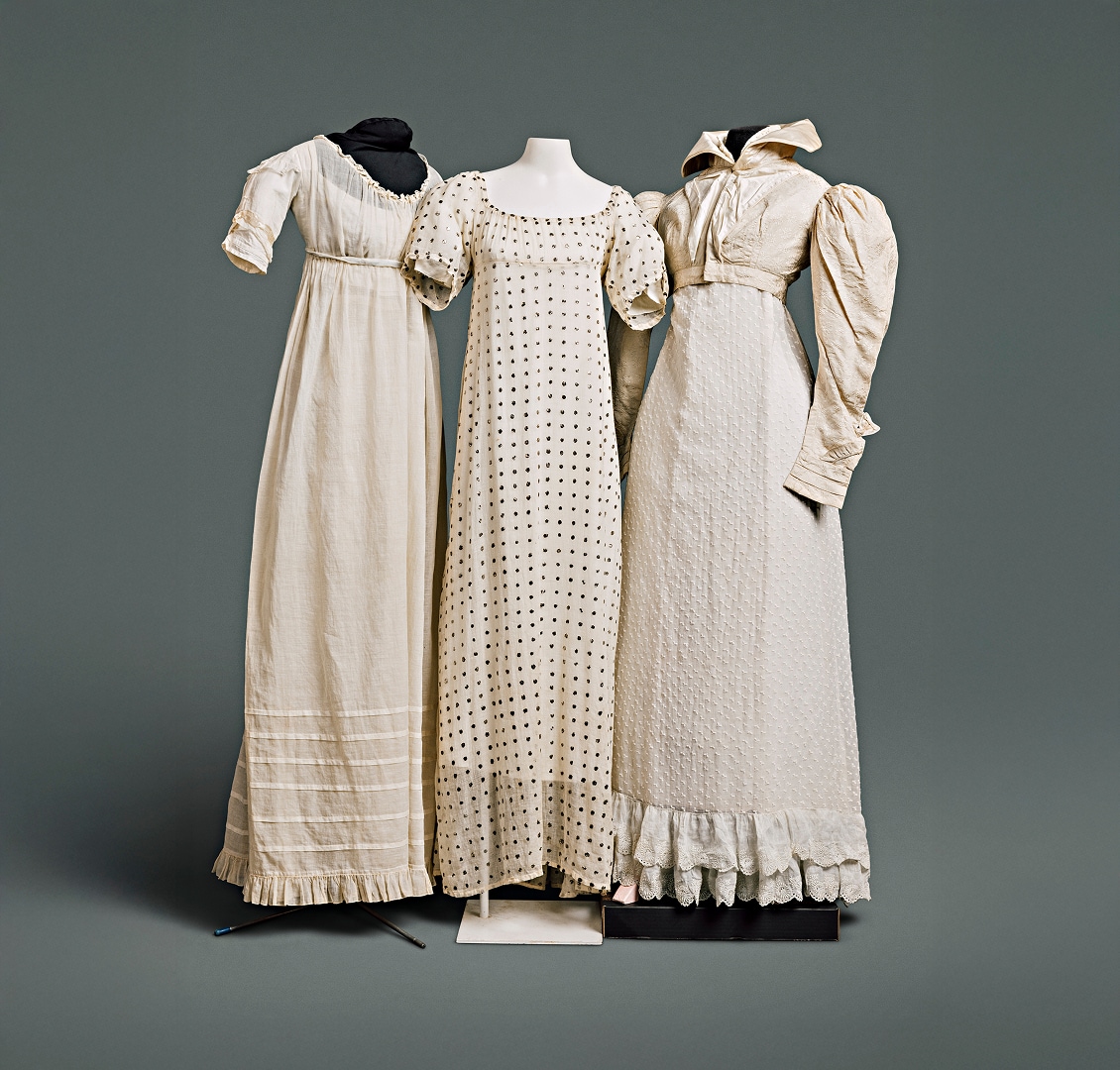
Dresses and Jacket
Dress – c. 1793 | Scottish, cotton
In the last decade of the 18th century, the main garments were frequently white or predominantly white, while colour was likely to appear in accessories. Loose garments were usually tied in place with drawstrings or ribbons or secured with straight pins. A fashionable woman stood relaxed and slightly stooped, in a position known as “The Grecian Bend”. The goal was to resemble the women or goddesses depicted in 5th century BCE classical Greek statuary. The fascination with Greek aesthetics was motivated by interest in the newly revived concept of democratic government, initiated in Ancient Greece and evidenced by the American and French Revolutions.
Dress – c. 1810 | English, cotton (India)
The dress is a simple structure held in place by drawstrings. The fabric is semi-transparent and would have been worn over a shift or slip of matching shape. The fabric is decorated with silver-plated metal filaments in a technique known as thumbnail embroidery. The metalwork was flattened between the thumbnails of the embroiderer to create a reflective surface best appreciated in a candle-lit ballroom. The embroidery could appear in floral patterns or complex borders, as well as simple geometries.
Dress – c. 1815–1820 | Scottish, cotton (India)
Spencer Jacket – c. 1817–1820 | Scottish, cotton (India)
The silhouette here is more geometric and less organic than it had been in earlier decades. This predicts the extreme moral conservatism evident in fashion at the beginning of the Victorian era (1837), when high necklines, long sleeves and layered full skirts covered the body entirely.
Collection
Ivan Sayers collection