Dressed for History

Women’s Fashion 1750–2000

Just as fashion constantly evolves, it is continuously informed and held together by a common thread: the past. This exhibit highlights the importance of collecting and preserving the clothing of the past in order to inform the future.

Loading…
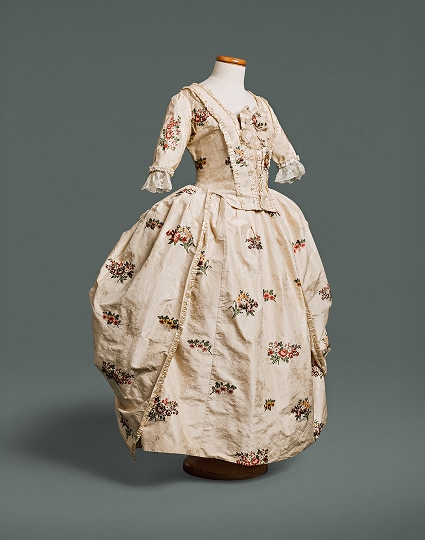
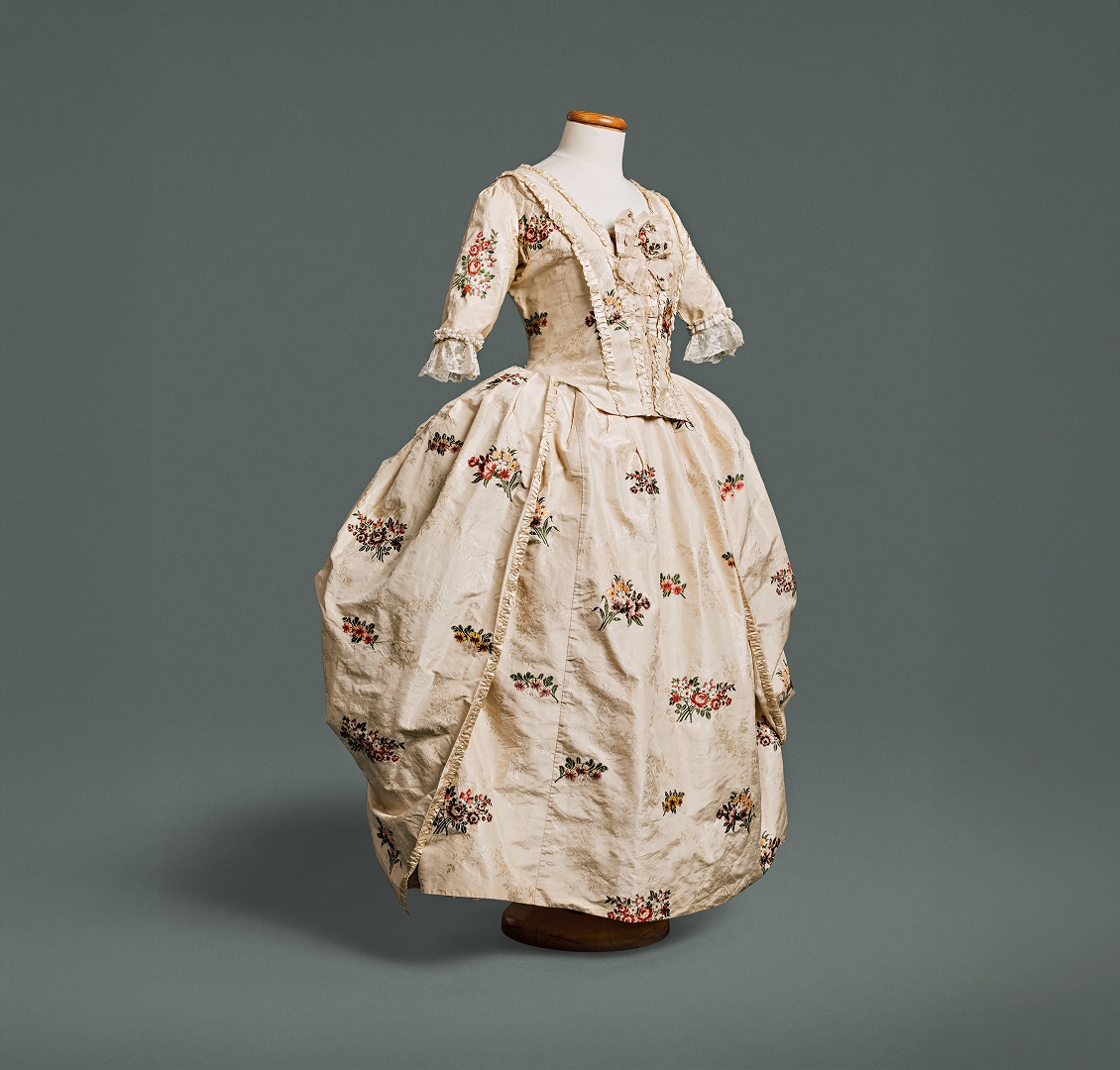
A gown with a bodice fitted at front and back, and a waistline marked by a seam, made of silk decorated with flowers against a white background.

Robe à l’anglaise and Petticoat

c. 1750–1770 | English, silk

A robe à l’anglaise is a gown with a bodice fitted at front and back, and a waistline marked by a seam. The centre back panel of the bodice is often continued below the waist to be incorporated into the skirt.

The fabric is decorated with flowers against a white background, which shows similar damask woven flowers, white on white. This style of silk is typical of English fabrics of the 1750s, and at least three garments of this identical fabric are known to exist.

Under the gown, the woman would have worn a shift, stays, panniers (side hoops), and a petticoat, as well as stockings and garters. The effect was ornamental and, although voluminous, light. The panniers show off the fabric and create contrast with the size of the waist.

Collection

Ivan Sayers collection
Loading…
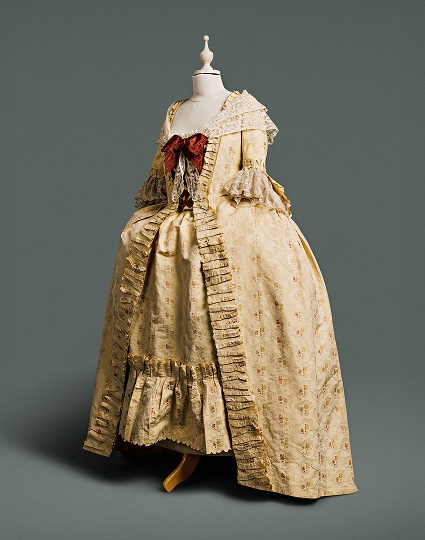
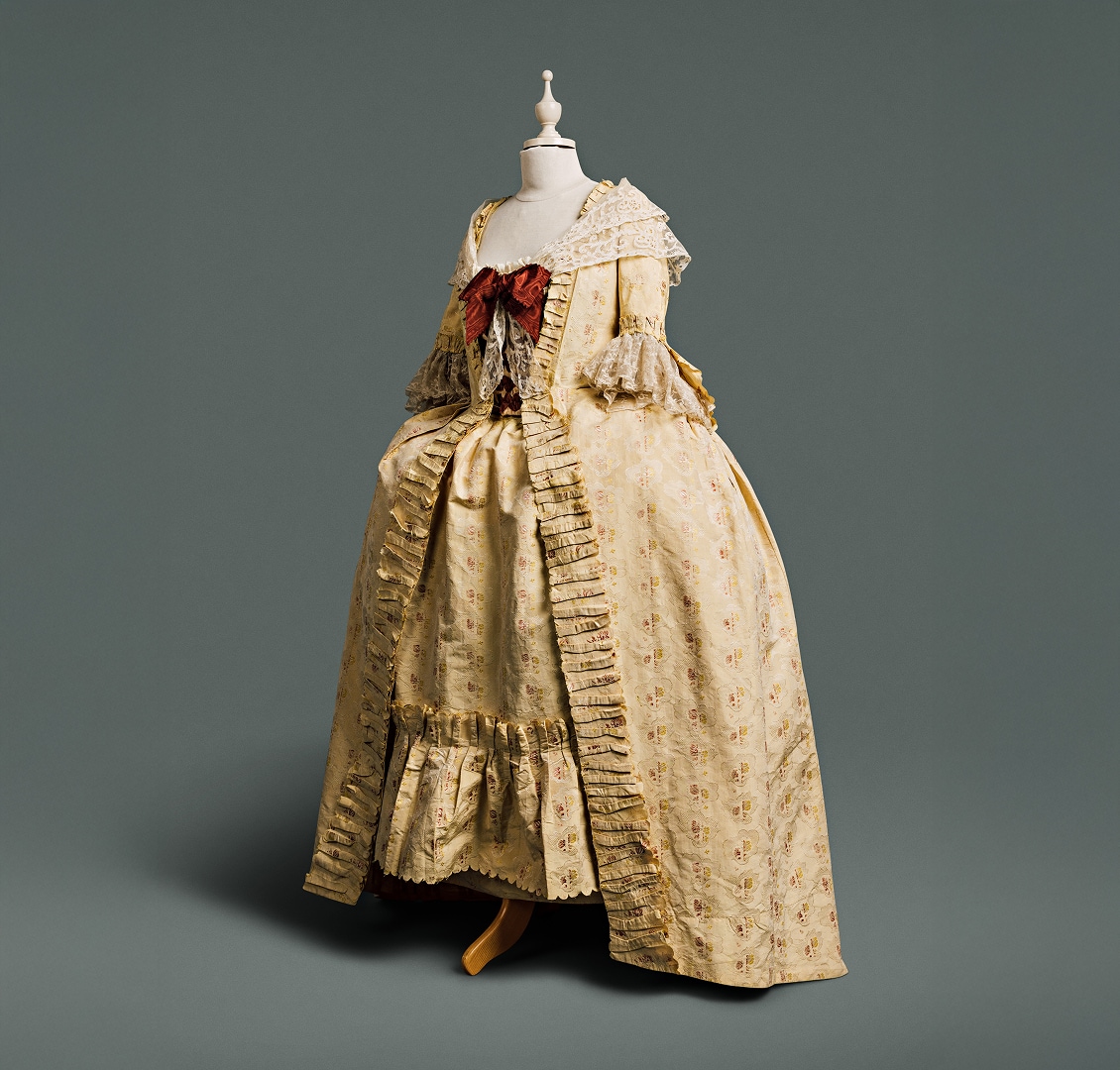
A cream-coloured gown features a loose panel at the back of the bodice, displaying large amounts of expensive cloth patterned with pomegranates, roses, and other flowers against a damask woven pattern of lace bands. A large auburn bow and lace shawl are draped across the top of the gown.

Robe à la française and Petticoat

c. 1765–1775 | English or American, silk

A robe à la française featured a loose panel at the bodice back, displaying large amounts of expensive cloth. The petticoat and skirt were supported by side hoops made of cane or whalebone, which displayed the fabric and enhanced the smallness of the waist.

The fabric is probably English and slightly older (c. 1745–1750s) than the garment. The brocade pattern shows pomegranates, roses, and other flowers against a damask woven pattern of lace bands.

The skirts of both the robe à la française and the robe à l’anglaise could be worn loose or draped into three sections in a form called a polonaise. This name was given to the skirts as an attempt at political satire. In the 18th century, Russia, Prussia, and Austria seized sections of Poland. This tripartite division of Polish territory was seen as similar to the division of the skirt. More likely, the raising of the skirt was simply intended to keep the valuable fabric off the floor.

Collection

Ivan Sayers collection
Loading…
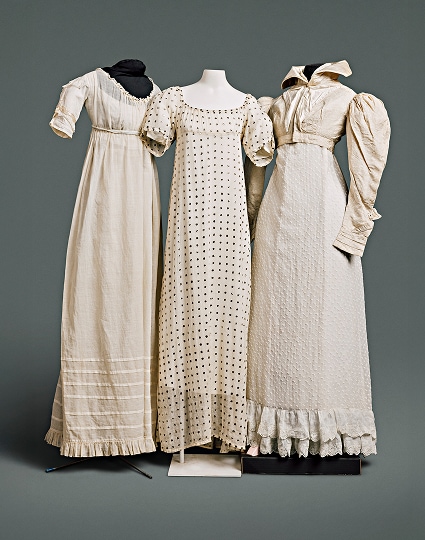
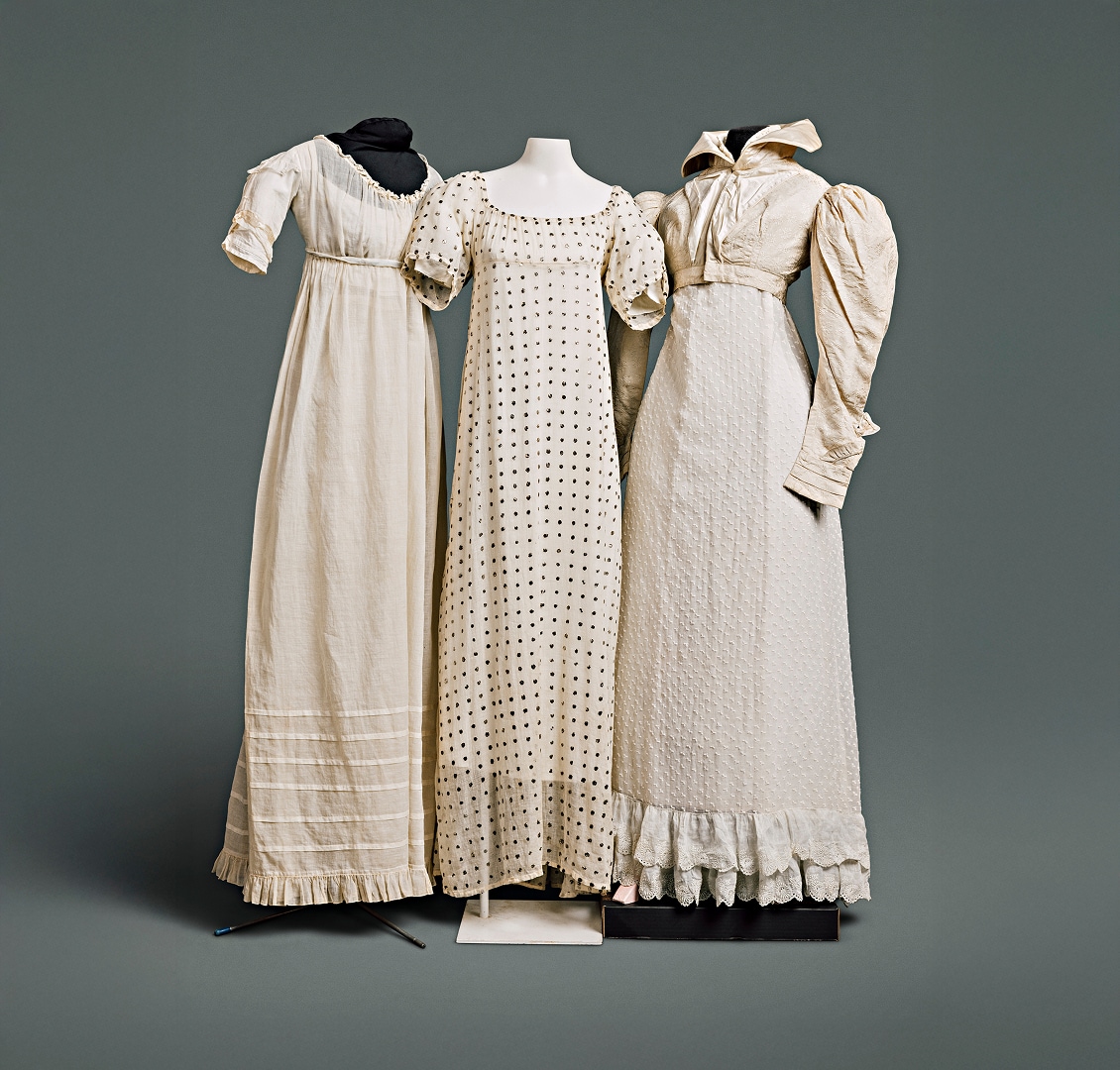
Three cotton dresses with simple patterns and sleeves extending to just above the elbow. One of the dresses is accompanied by a cotton Spencer jacket with high collar covering the neckline.

Dresses and Jacket

Dress – c. 1793 | Scottish, cotton

In the last decade of the 18th century, the main garments were frequently white or predominantly white, while colour was likely to appear in accessories. Loose garments were usually tied in place with drawstrings or ribbons or secured with straight pins. A fashionable woman stood relaxed and slightly stooped, in a position known as “The Grecian Bend”. The goal was to resemble the women or goddesses depicted in 5th century BCE classical Greek statuary. The fascination with Greek aesthetics was motivated by interest in the newly revived concept of democratic government, initiated in Ancient Greece and evidenced by the American and French Revolutions.

Dress – c. 1810 | English, cotton (India)

The dress is a simple structure held in place by drawstrings. The fabric is semi-transparent and would have been worn over a shift or slip of matching shape. The fabric is decorated with silver-plated metal filaments in a technique known as thumbnail embroidery. The metalwork was flattened between the thumbnails of the embroiderer to create a reflective surface best appreciated in a candle-lit ballroom. The embroidery could appear in floral patterns or complex borders, as well as simple geometries.

Dress – c. 1815–1820 | Scottish, cotton (India)

Spencer Jacket – c. 1817–1820 | Scottish, cotton (India)

The silhouette here is more geometric and less organic than it had been in earlier decades. This predicts the extreme moral conservatism evident in fashion at the beginning of the Victorian era (1837), when high necklines, long sleeves and layered full skirts covered the body entirely.

Collection

Ivan Sayers collection
Loading…
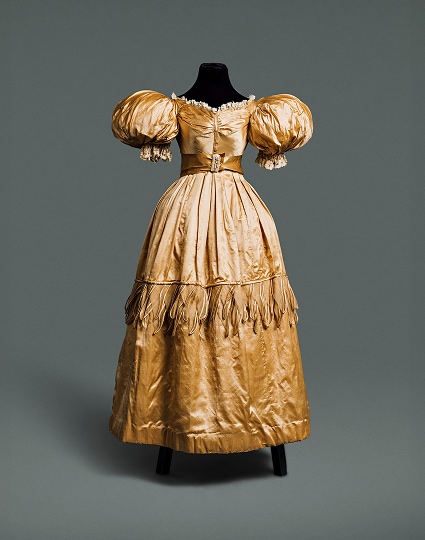
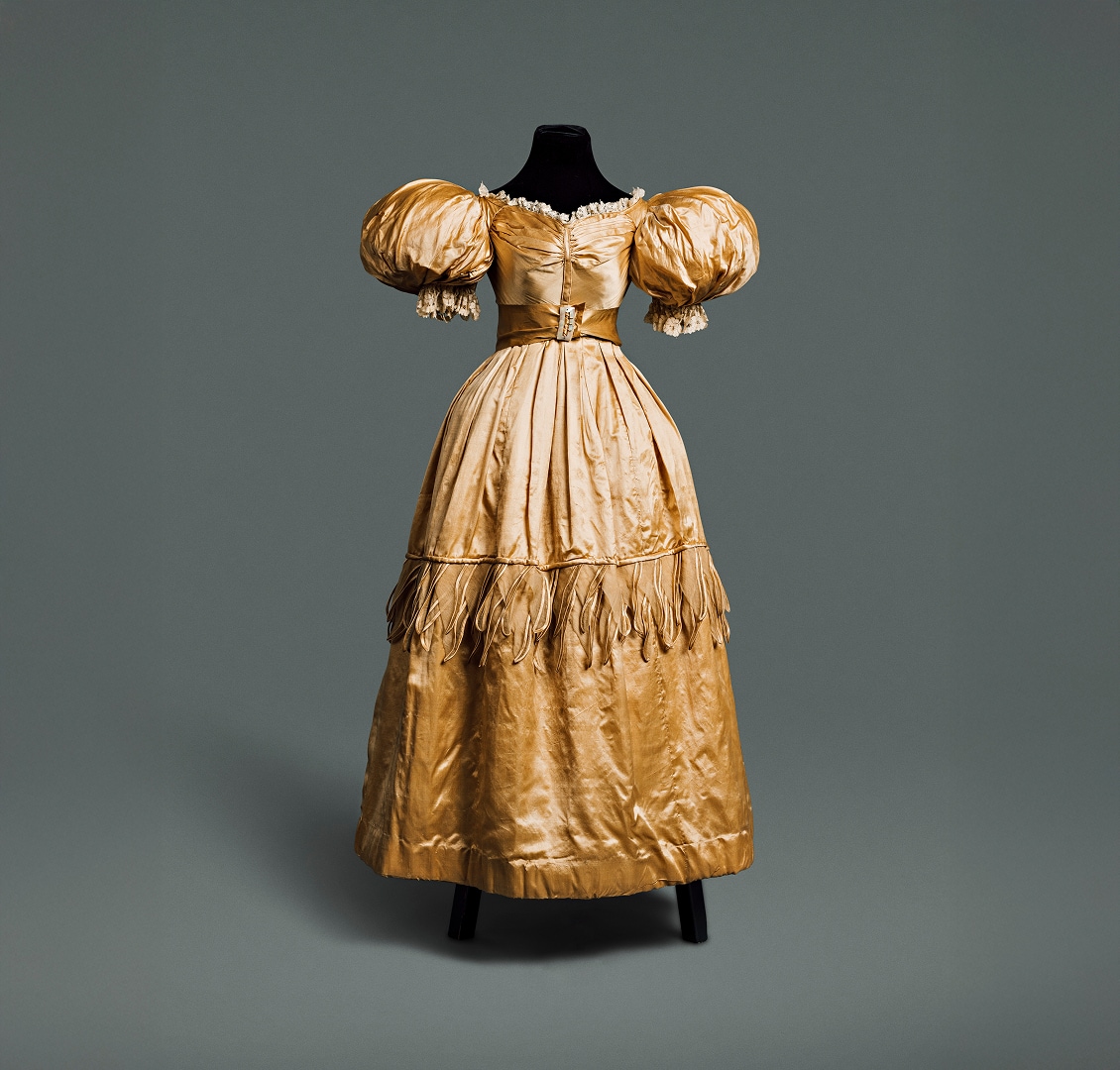
Gold silk gown with long wide skirt, puffy sleeves around the shoulders, and a narrow waistline accented by a belt made of similar material.

Evening Dress

c. 1830–1835 | Irish, silk

By the mid 1830s, the natural figure was displayed primarily at the waist, which was tightly corseted. The shoulders and legs were obscured with massive sleeves and full skirts (both heavily padded). Despite the growing volume of the skirt, hems were usually well short of the ground, giving the wearer a light, floating appearance.

Collection

Ivan Sayers collection
Loading…
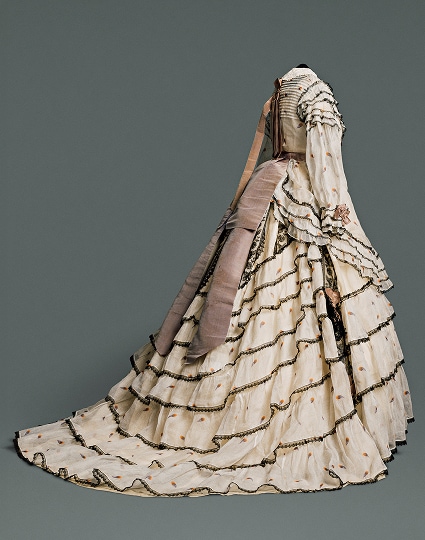
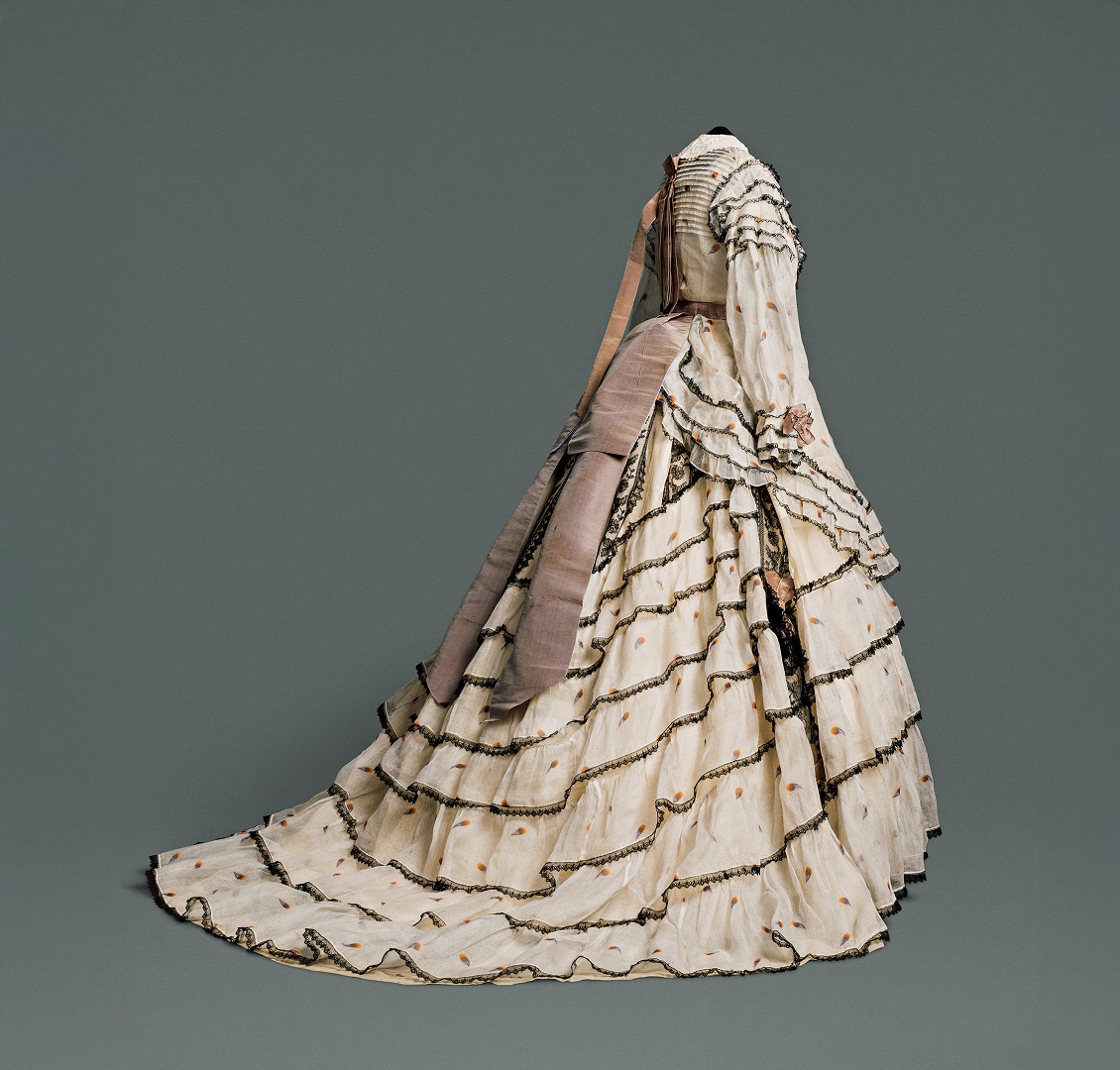
A long, voluminous skirt made of multiple cream-coloured patterned cotton and linen layers accented with black lace. A light brown sash hangs down from the waistline at the back of the dress.

Afternoon Dress

c. 1866 | American, linen and cotton

By the early 1860s, the skirts had taken on a more triangular shape. The volume had begun to shift towards the back, and the prime angle of perception shifted from the front to the side.

The graceful sweep of the skirt of this dress is supported by its original hooped underskirt and petticoat. The organdy fabric is printed with peacock feather eyes, and the copious amounts of lace are mechanically produced.

Collection

Ivan Sayers collection
Loading…
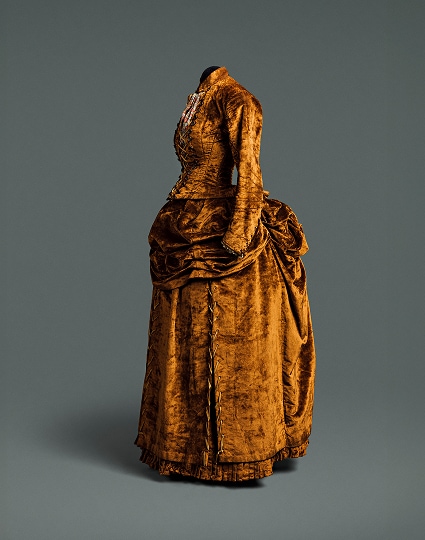
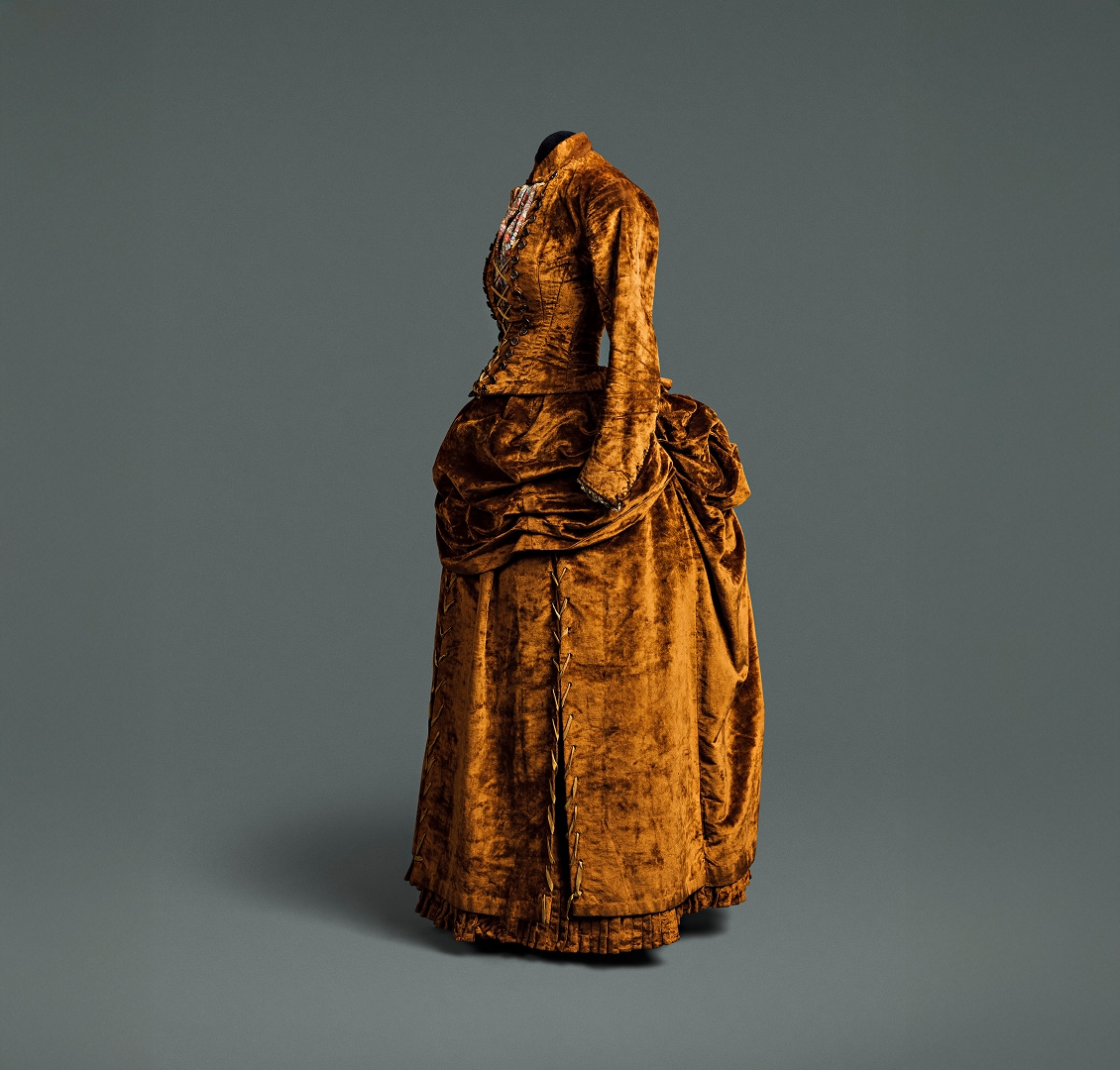
A dark ochre dress consisting of a separate bodice and skirt. The dress is accented with decorative brown buttons extending down the front of the bodice which is laced together with a gold cord.

Day Dress

c. 1886 | Canadian, cotton

The dress is made with a separate bodice and skirt and features the large, right-angle bustle typical of the mid 1880s.

The dress was made by a competent but unskilled sewer using a pattern illustrated in the Butterick Pattern Catalogue printed in 1886. The catalogue survived in the O’Reilly family home (Point Ellis House) in Victoria, and although the dress was found in Chilliwack, it too may have come from the O’Reilly home.

Collection

Ivan Sayers collection
Loading…
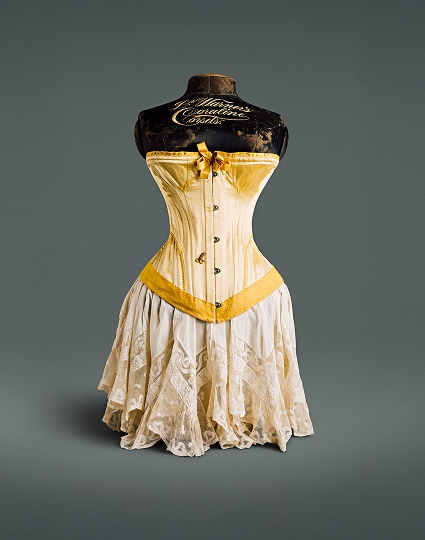
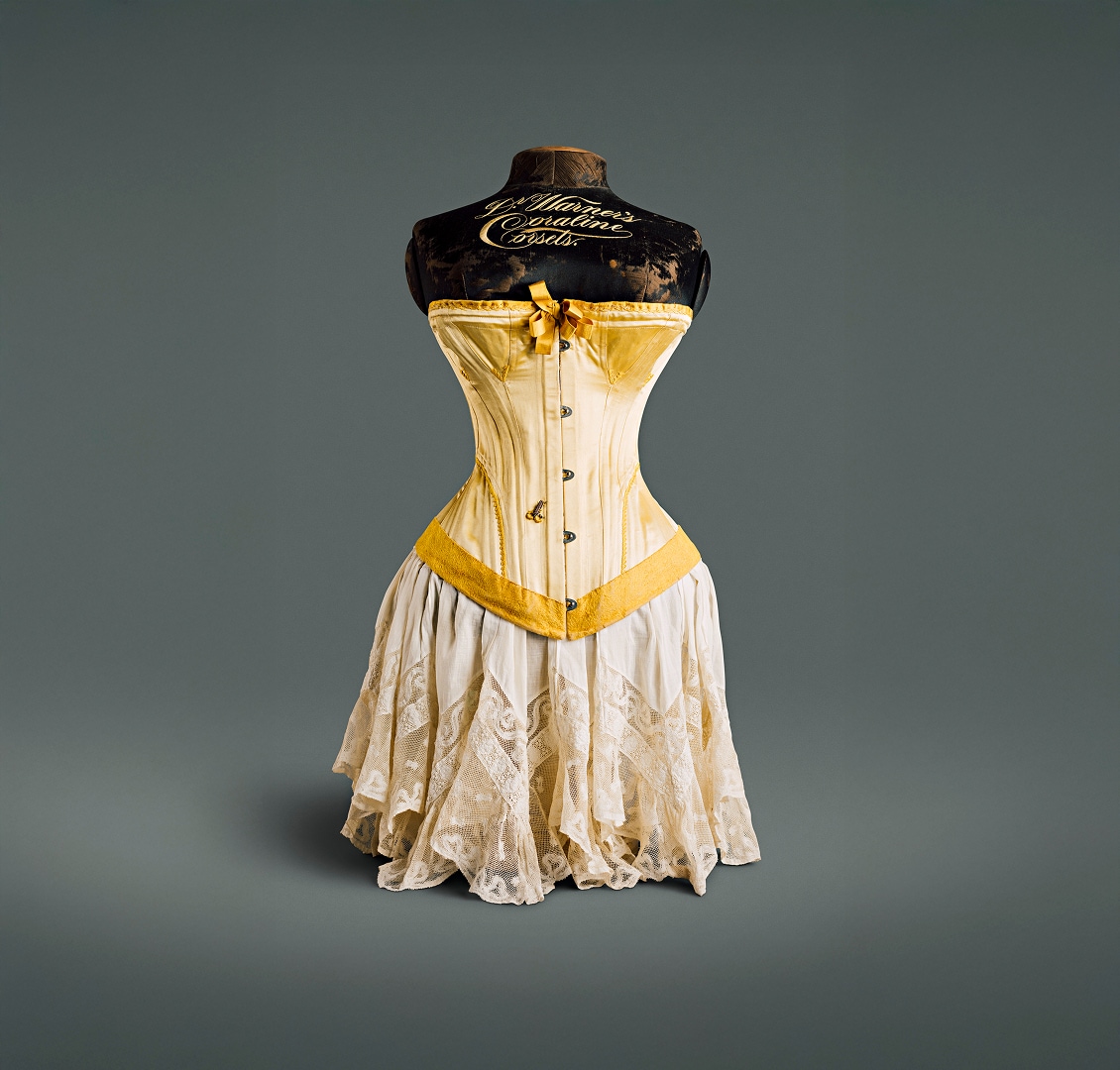
A canary yellow silk corset with bow at the bosom, plush hemline, and metal fastening hooks.

Corset and Form

c. 1890 | Spanish, silk

The canary yellow colour of this beautiful silk evening corset is uncommon. The corset is intricately cut with narrow darts and gussets for elegant shaping and showcases hand-embroidered flossing. Plush trimmings along the hemline soften the edge of the corset under the dress. The hook on the right-side front of the corset was used to hold the petticoats below the waistline and reduce bulk.

Corset Form – c. 1890 | American, silk, cotton, formed cardboard

The corset is displayed on an original American dress form for “Dr. Warner’s Coraline Corsets”. These corset forms were reserved for special loans to retail stores for display purposes only. The base of the form has a paper label that reads: “Loaned by Warner Brothers”.

Collection

Melanie Talkington

Loading…
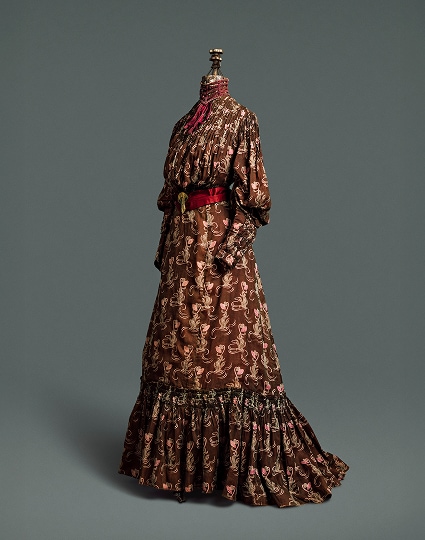
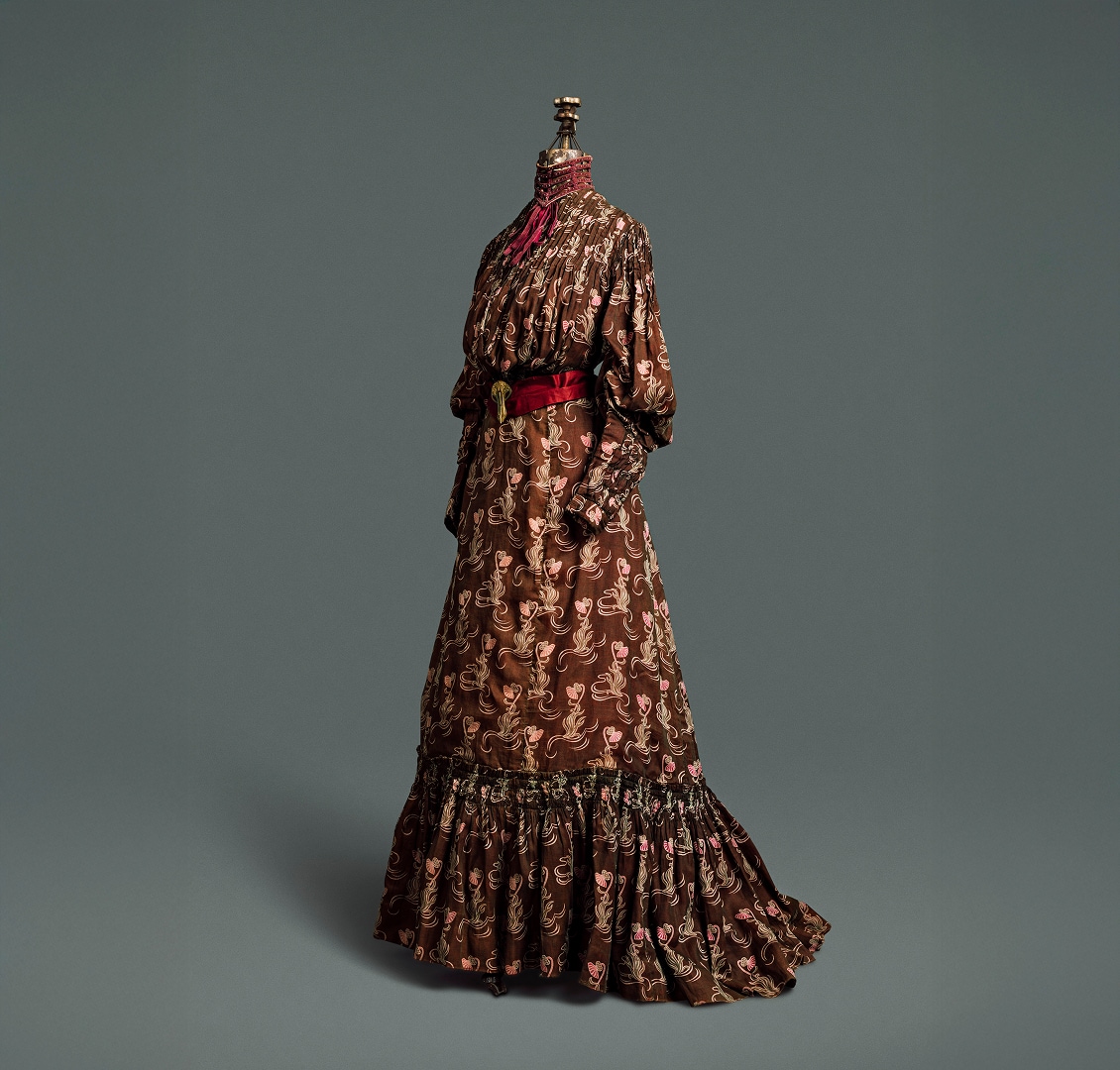
A four-piece dress made of chocolate-brown cotton material patterned with a light brown and pink thistle print. The dress is accented with a deep red silk belt, fastened by a gold clip, and collar.

Day Dress

c. 1903 | Canadian, cotton

The dress is in four pieces: bodice, skirt, collar and belt. Conspicuously padded in the bust and hips, the dress creates the S-shaped silhouette so popular at the time. Both the S-shape and the fluid thistle print on the fabric illustrate the organic, curvilinear aesthetic of the Art Nouveau style.

Collection

Ivan Sayers collection
Loading…
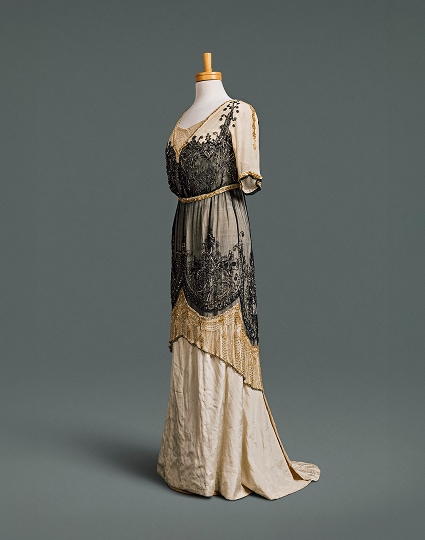
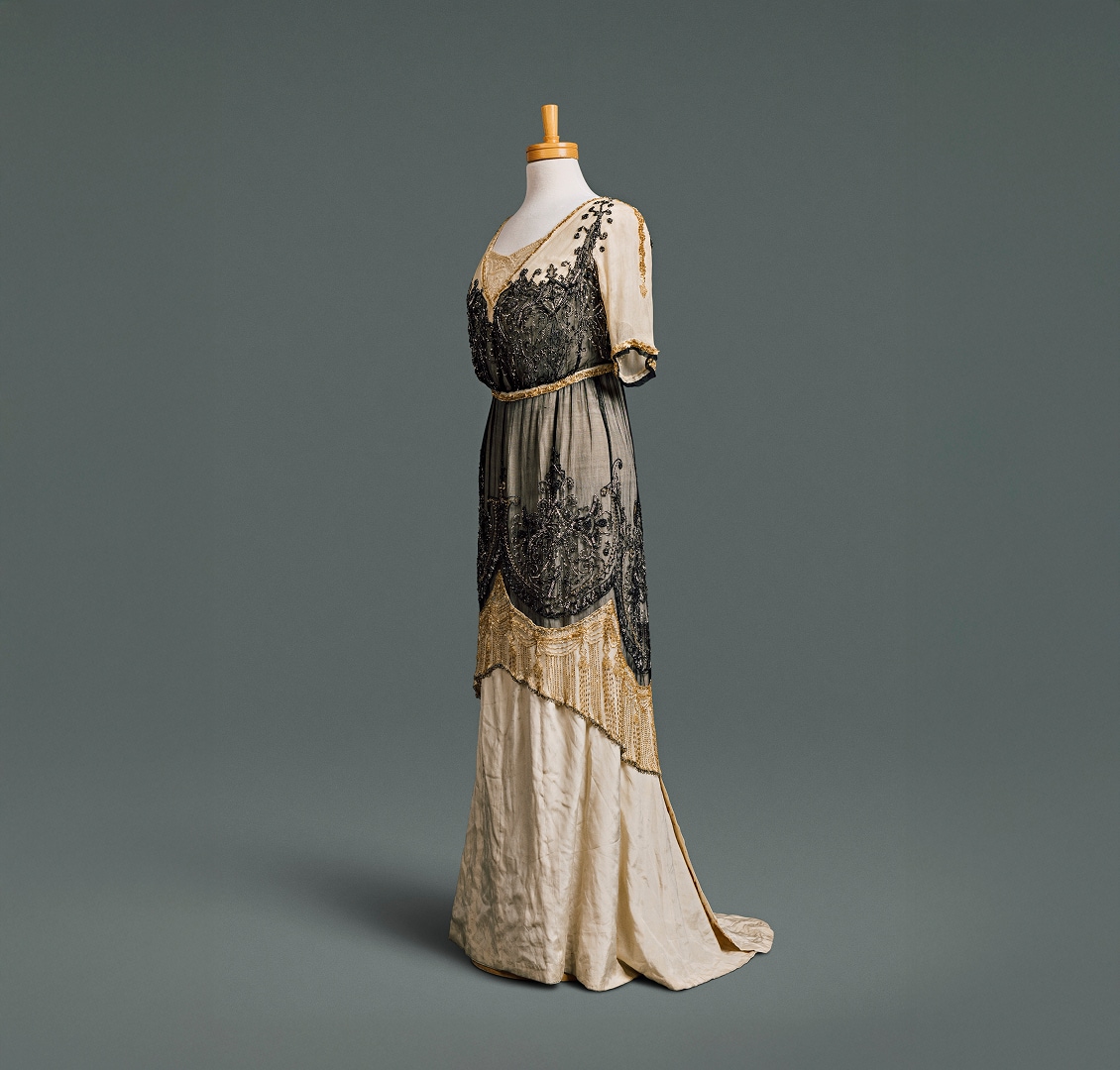
A long, narrow cream-coloured silk dress with low neckline and high waistline, overlayed with black and gold beaded tunic overskirt.

Evening Dress

c. 1910–1912 | German, silk

The high waistline is inspired by the Empire styles of c. 1810. The fringes and tunic overskirt would have been considered Eastern influences.

Königsberg was the capital of East Prussia. In 1946, the city became Kaliningrad, Russia.

Label

Modesalon Gebr. (Brothers) Faerber, Königsberg, i/Pr. (Prussia)

Collection

Claus Jahnke

Loading…
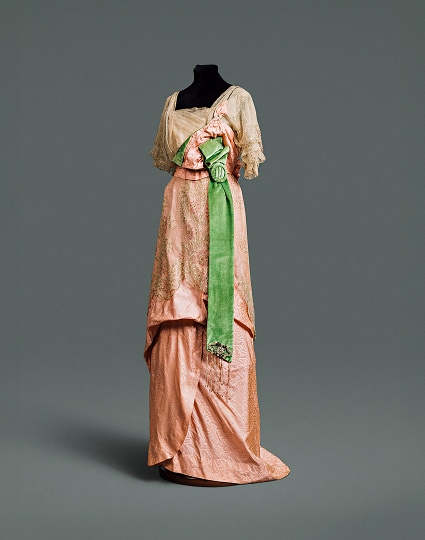
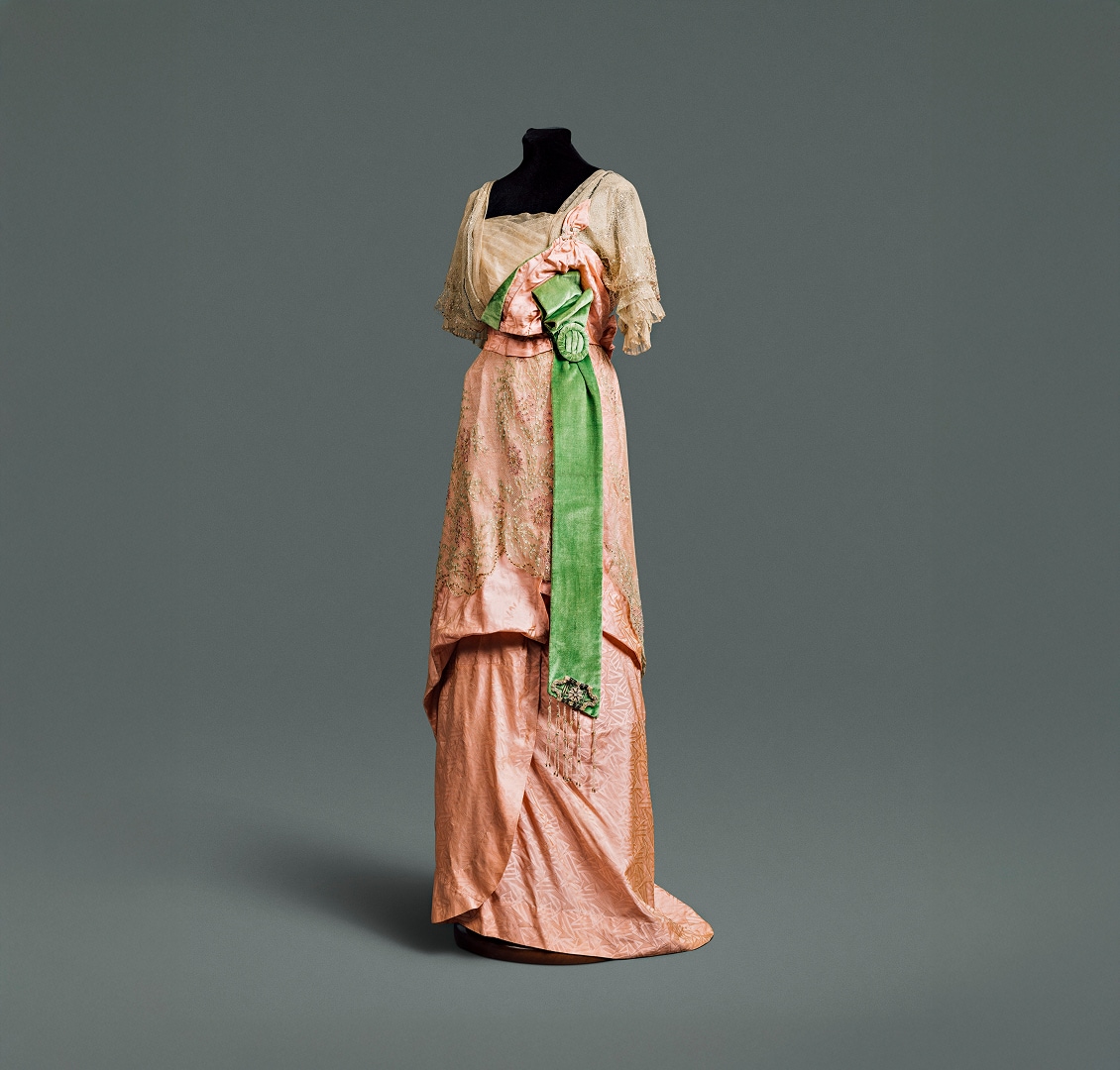
A pink silk dress with draped skirt and wide emerald green sash, covered by an intricate lace bodice and overskirt.

Evening Dress

c. 1913 | Canadian, silk and cotton

The dress has a draped skirt and wide sash reminiscent of the Japanese kimono and obi. The lace bodice and overskirt imitate the tunic traditionally worn in Eastern Mediterranean countries.

This dress originally belonged to Violet Murray, a Vancouver school teacher living in the West End of the city.

Collection

Ivan Sayers collection
Loading…
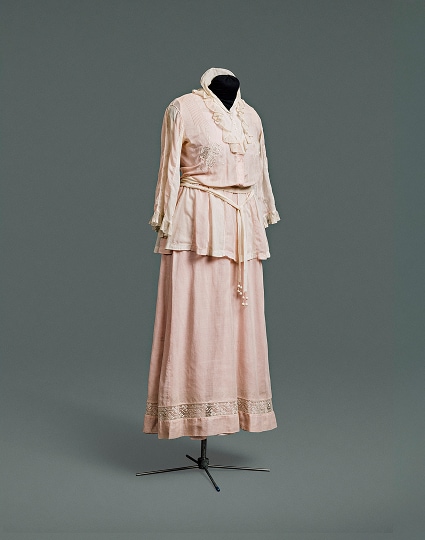
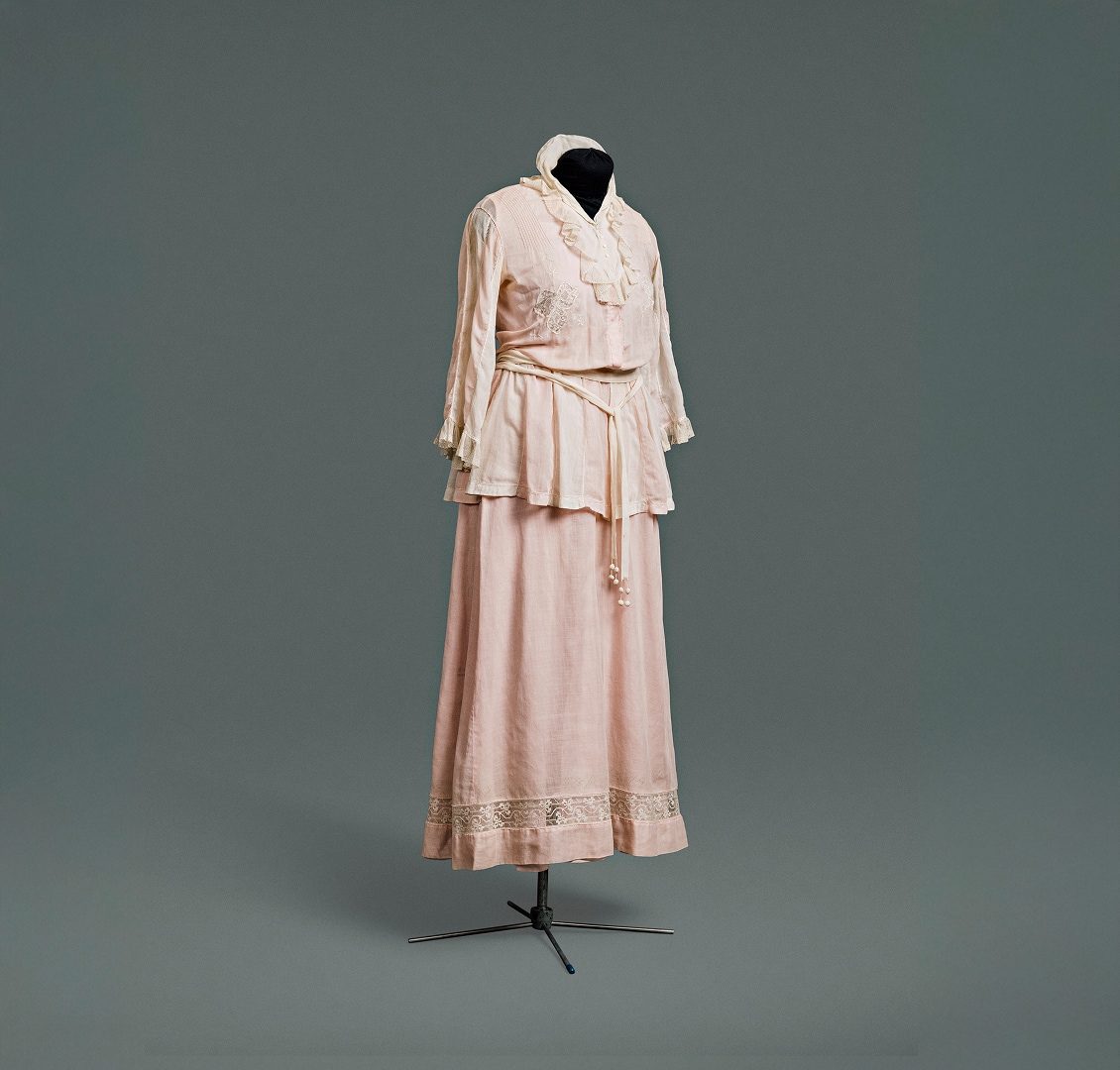
A simple pink cotton one-piece dress designed to appear to be a suit composed of a jacket over a blouse, worn with a matching skirt.

Afternoon Dress

c. 1917 | Canadian, cotton

The garment is in one piece and fastens at the front. These features make it easy to get on and off. Although all-in-one, the dress is created to appear to be a suit composed of a jacket over a blouse, worn with a matching skirt. The suit-like structure is in keeping with the seriousness of the times.

This dress was worn in New Westminster, BC.

Collection

Ivan Sayers collection
Loading…
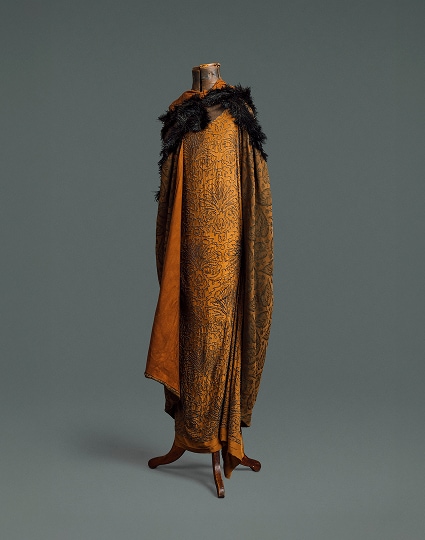
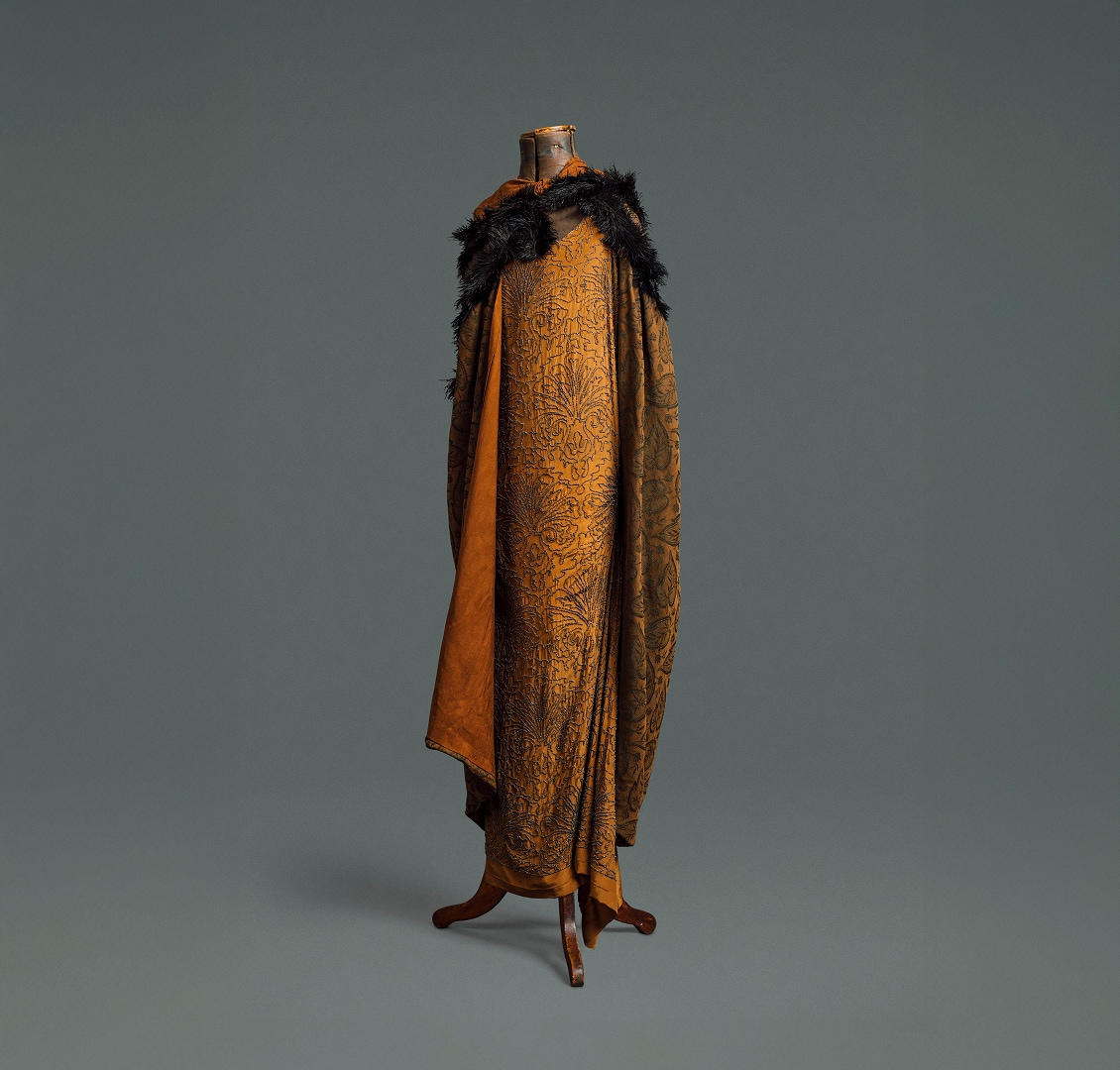
A long, loose dress made of auburn silk covered in a floral pattern made of black beads. Covering it is a matching cape made of heavier patterned material and a black feather boa.

Evening Dress and Cape

c. 1923–1924 | French, silk

The dress is loose, with the weight hanging from the shoulders. The hem is long, and the dress is heavily beaded by machine. The emphasis is on the surface rather than the cut of the garment.

The colour would have been known as “mummy brown”, inspired by the discovery of King Tutankhamen’s tomb in the winter of 1922.

Collection

Ivan Sayers collection
Loading…
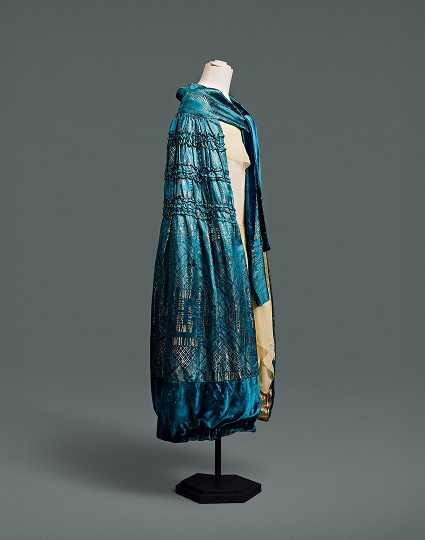
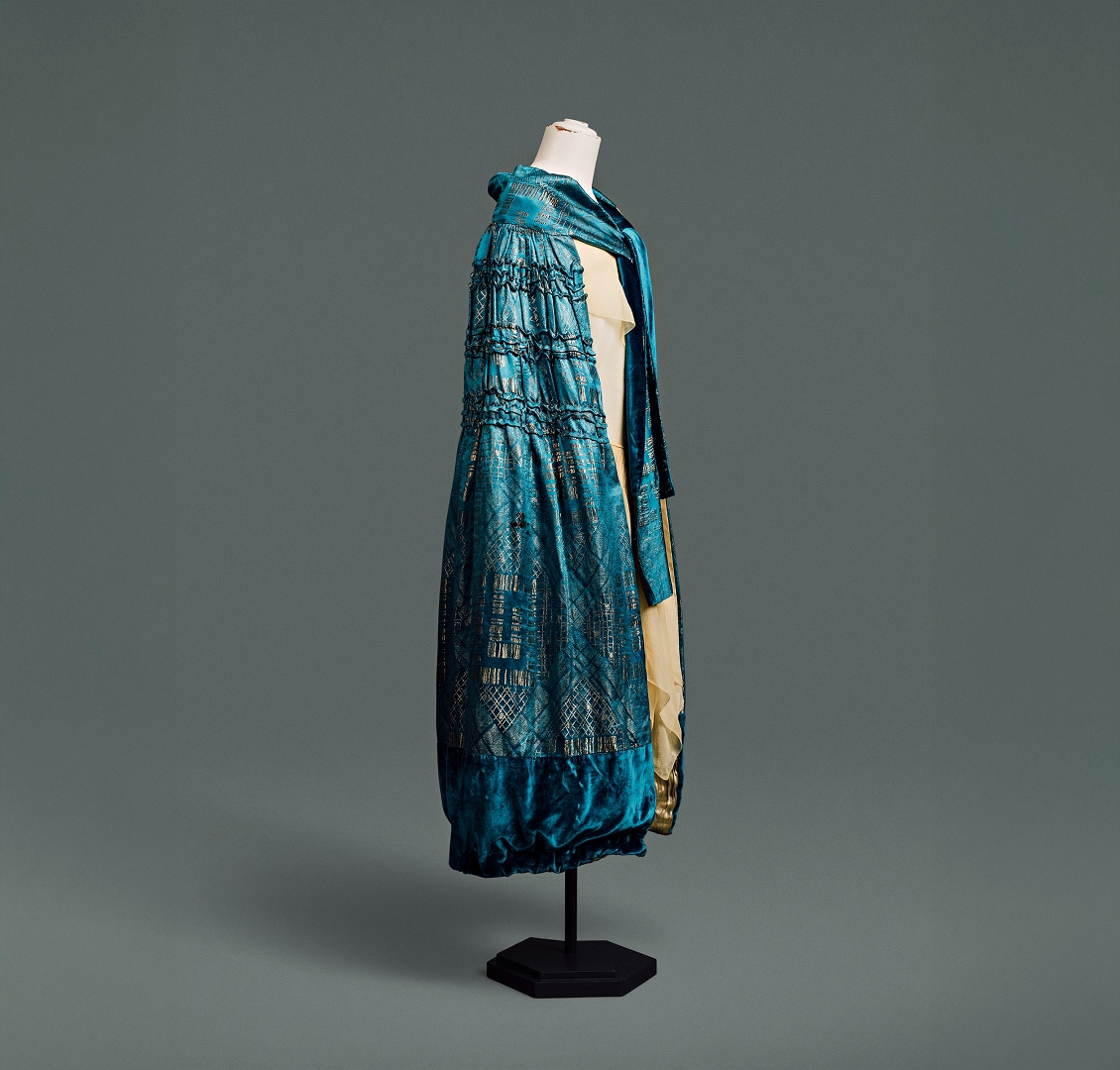
A blue silk cape covered in an Art Deco damask pattern of metallic gold geometric forms, hangs to just below knee length.

Evening Cape

c. 1925–1929 | Canadian, silk

The cape has a beautiful Art Deco damask pattern of metallic gold geometric forms. The overall cocoon shape disguises the contours of the body.

The cape was in the costume wardrobe of actor Ross Hamilton when he performed as the character “Marjorie” with the Dumbells in Vancouver in the 1920s. The Dumbells were a theatre troupe attached to the Canadian Army during WWI. They entertained soldiers stationed in Britain and Europe who were waiting to be sent into battle.

The Dumbells were so popular that they continued to perform across Canada long after the war ended. This cape was left with a Vancouver dressmaker for repair and was never claimed.

Collection

Ivan Sayers collection

Loading…
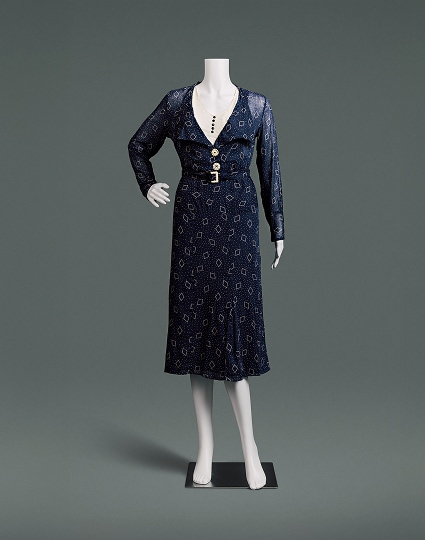
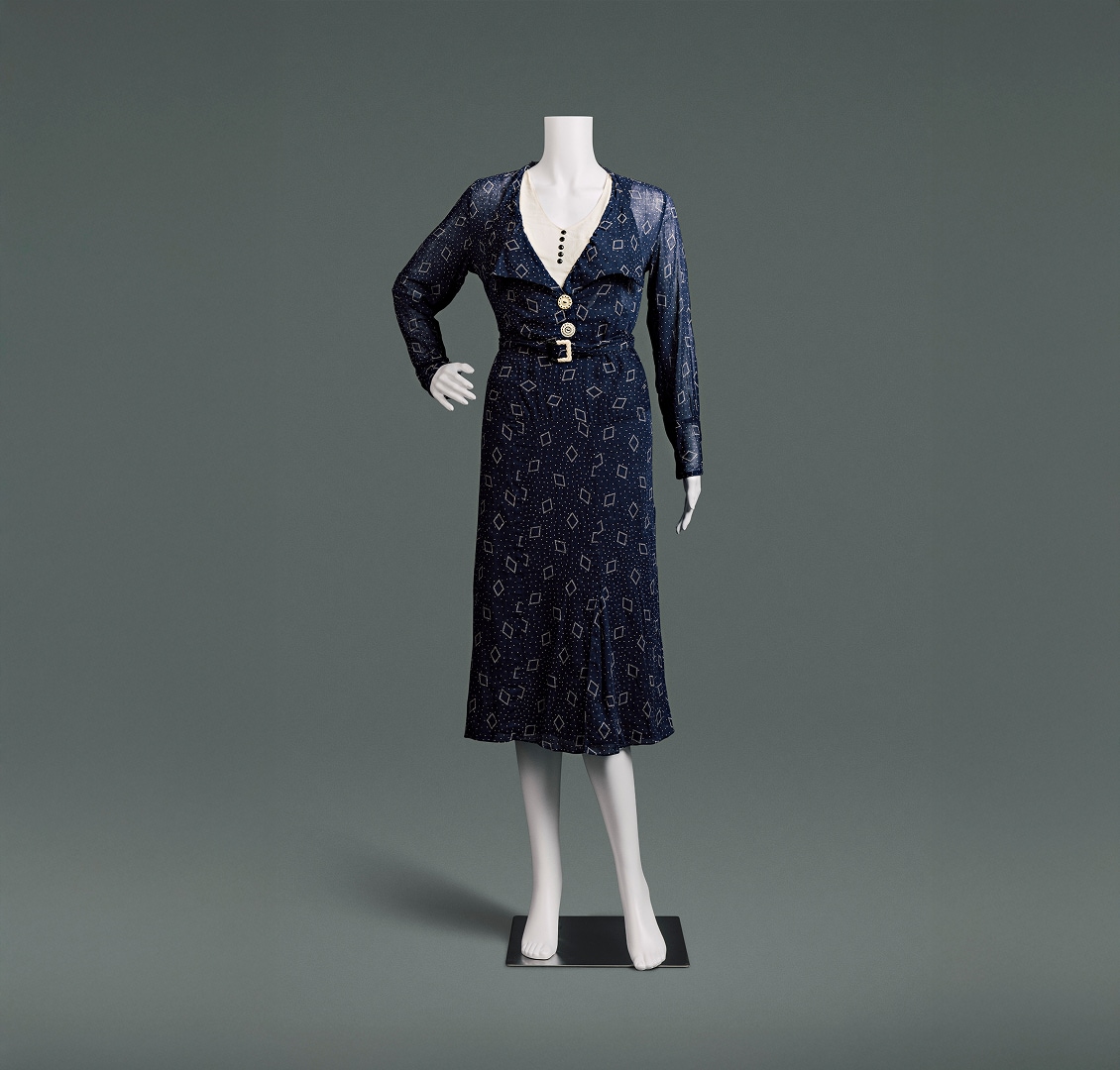
A slim fitting, midnight blue cotton dress with a high waist, and a skirt that comes down just below the knees. The material is covered with small polka dots and a diamond shaped pattern.

Day Dress

1933 | Canadian, cotton

The dress has a high waist, long skirt and slim fit. It is inexpensive and factory-made; only the buttons, which are not properly matched, are sewn by hand.

The dress appeared in Simpson’s mail order catalogue mid-summer 1933 and sold for $2.59

Collection

Ivan Sayers collection

Loading…
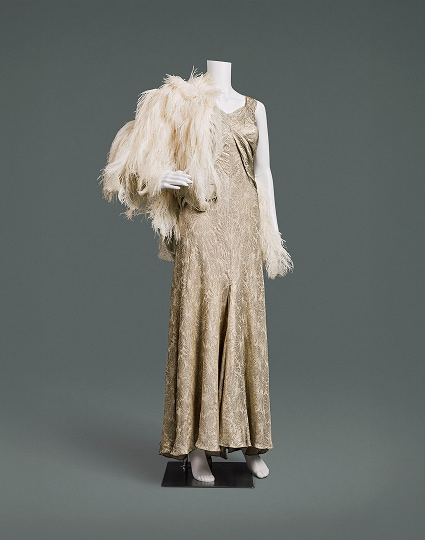
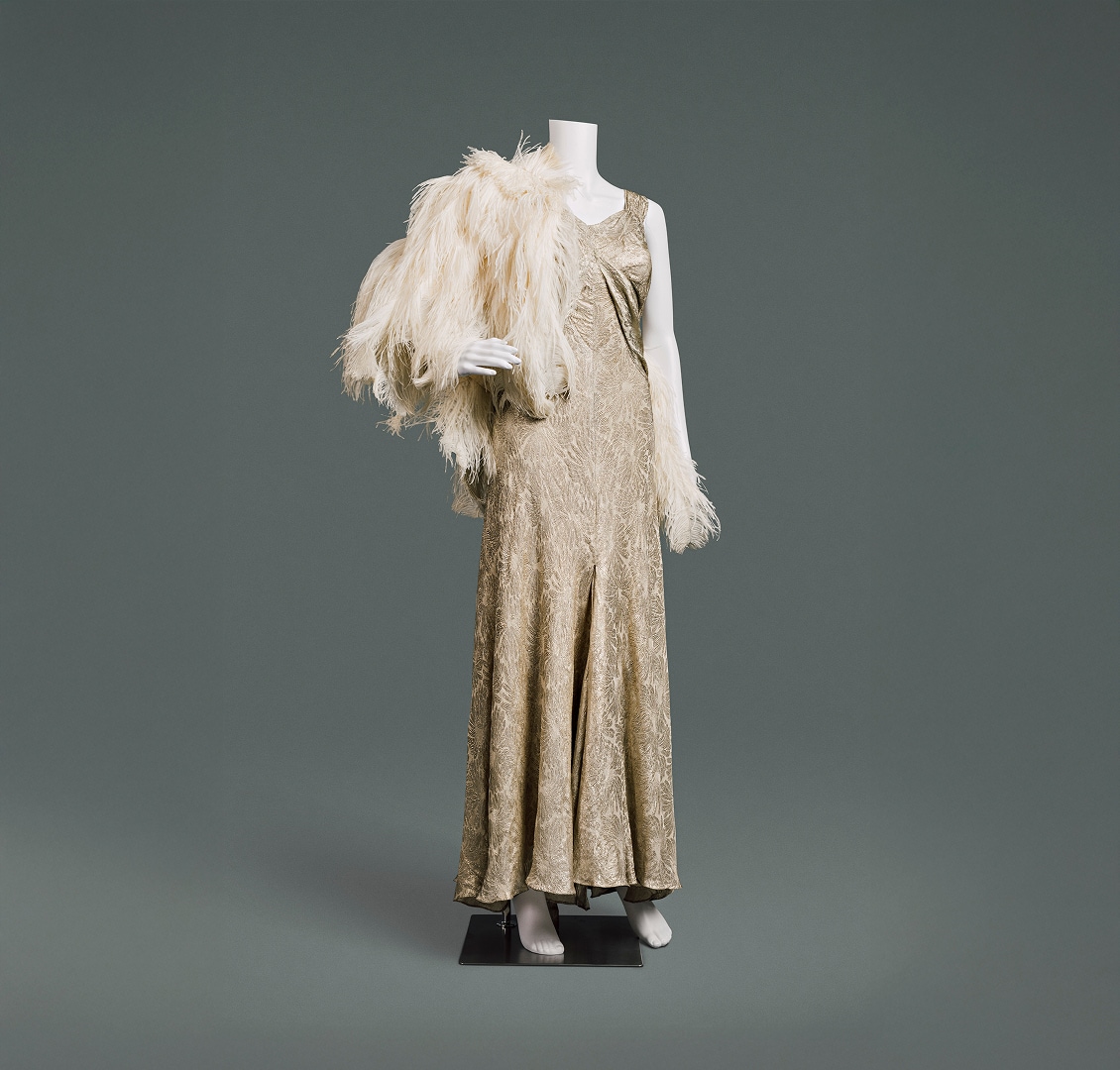
A glamorous gold-patterned silk lamé sleeveless evening gown with feather cape.

Evening Dress

c. 1938 | Canadian, silk lamé

By the end of the 1930s, a more modest display of the figure was fashionable. Earlier 1930s dresses clung more to the figure. Later dresses drew attention to the waistline specifically.

The Donaldson’s was one of Vancouver’s prestigious fashion houses of the period.

Label

Donaldson’s Vancouver

Collection

Ivan Sayers collection

Loading…
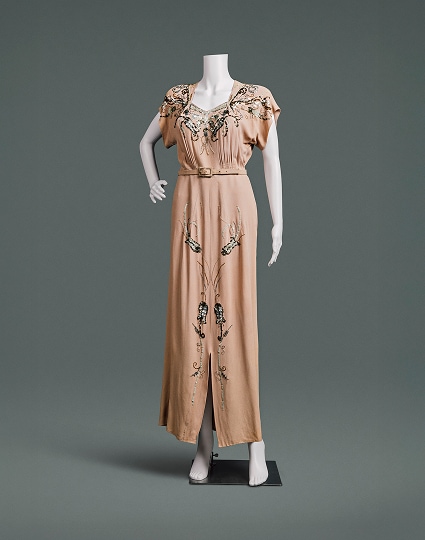
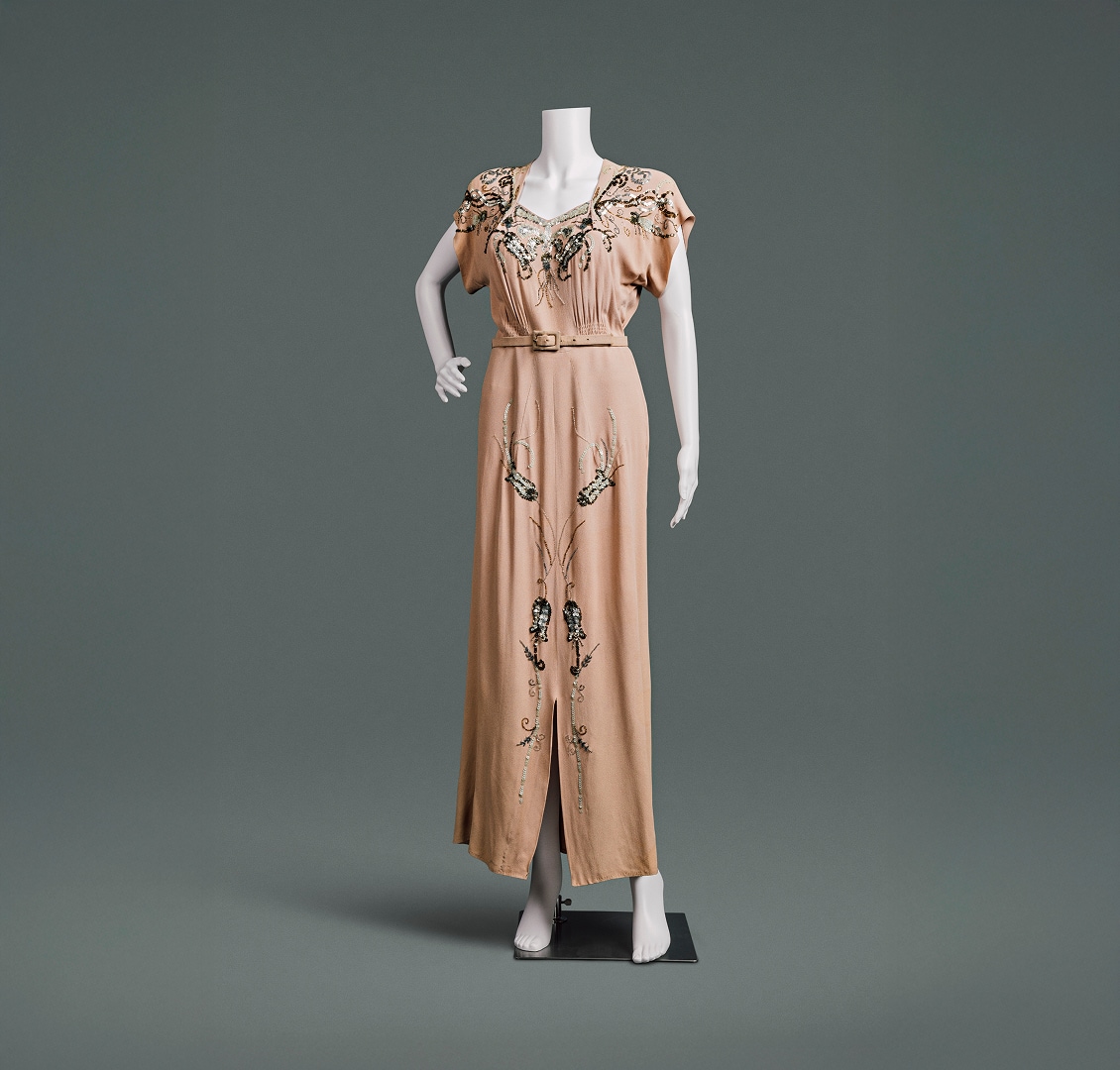
A peach-coloured dress with beaded floral accents, heavily padded shoulders, and a slim skirt. A high waistline is accented by a thin belt made of the same material.

Evening Dress

1946 | Canadian, rayon

The dress has heavily padded shoulders and a slim skirt. It appeared in the fashion magazine Mayfair in December 1946, printed in Toronto, Ontario.

Although post WWII, it retains the style popular in wartime 1940s.

This garment was originally in the wardrobe of Mrs. Moe, U.B.C.

Label

Styled by Sam Sherkin, Toronto

Collection

Ivan Sayers collection

Loading…
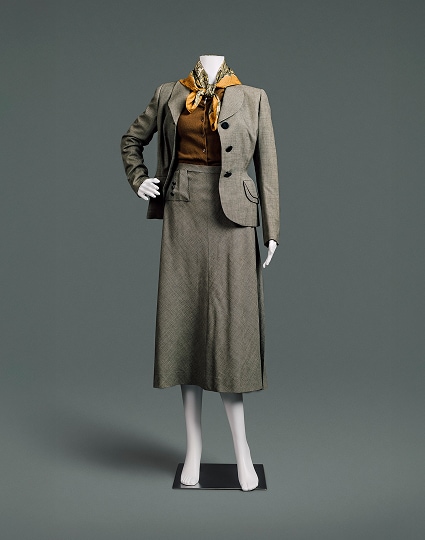
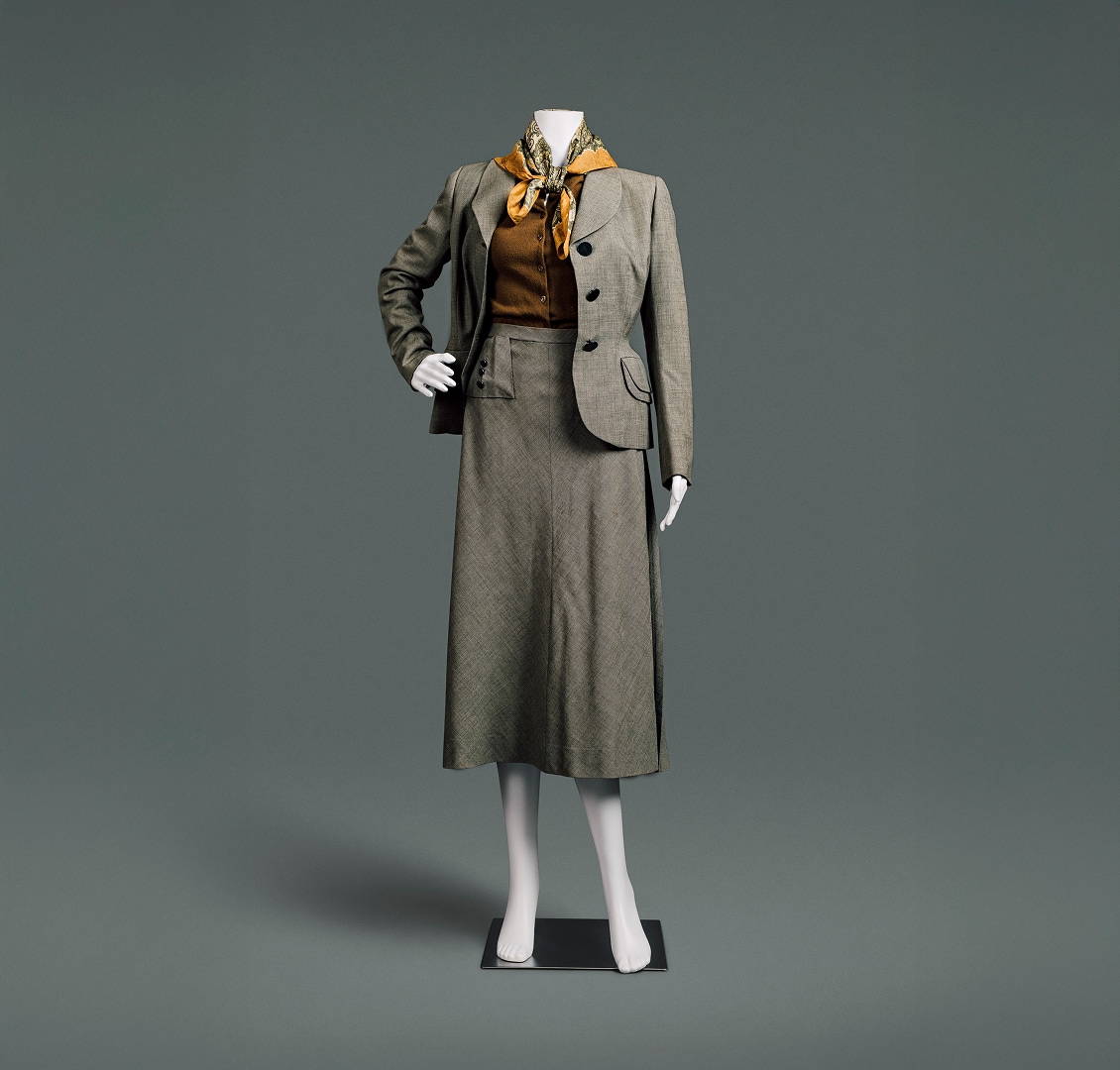
An English grey wool suit with jacket and skirt. The suit features broad, sloping shoulders over an auburn button-up blouse, a tiny waistline, and a longer, ample skirt. A paisley scarf around the neck provides a perfect accent.

Going Away Suit

1949 | English, wool

The suit illustrates all the features of “New Look” design: broad, sloping shoulders, a tiny waistline and a longer, ample skirt.

This outfit was sold in the “French Room” of the Hudson’s Bay Store in Vancouver and was worn by Mrs. Barbara Robinson as her going away outfit in 1949.

Label

Hardy Amies, 14 Savile Row, W1

Collection

Ivan Sayers collection

Loading…
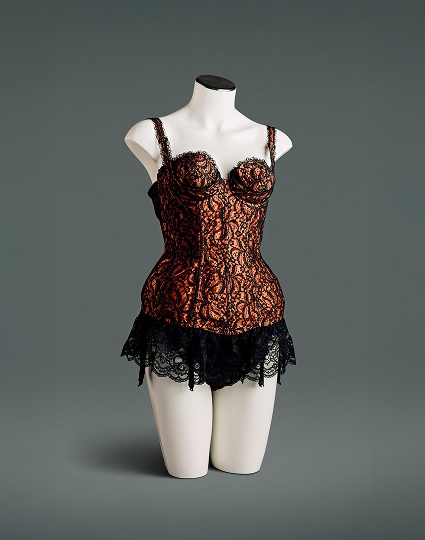
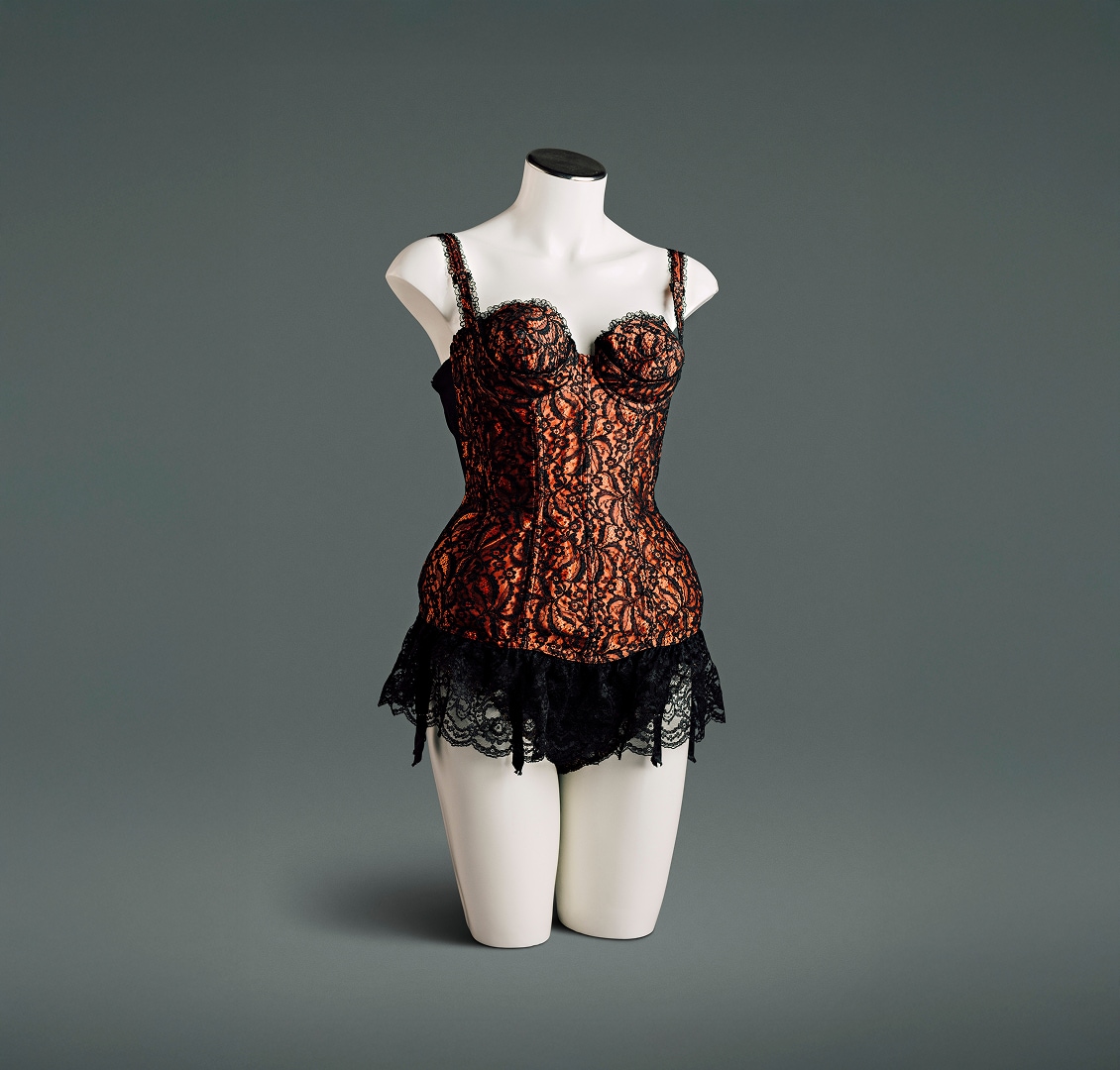
A nylon satin bustier with black lace overlay features a circle-stitched bullet bra with sling under-cups, power mesh elastic panels at both sides and the back, a deep lace flounce, and attached stocking suspenders.

Merry Widow Bustier

1950s | Italian, nylon satin with black lace overlay and elastic mesh

This bustier features a circle-stitched bullet bra with sling under-cup. There are power mesh elastic panels at both sides and at the back, with a deep lace flounce and attached stocking suspenders.

Label

La Francesina, Via Ponte Seveso 31. Milano. Tel 680665

Collection

Melanie Talkington

Loading…
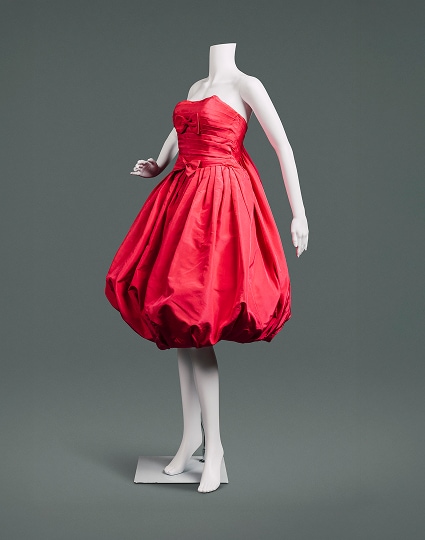
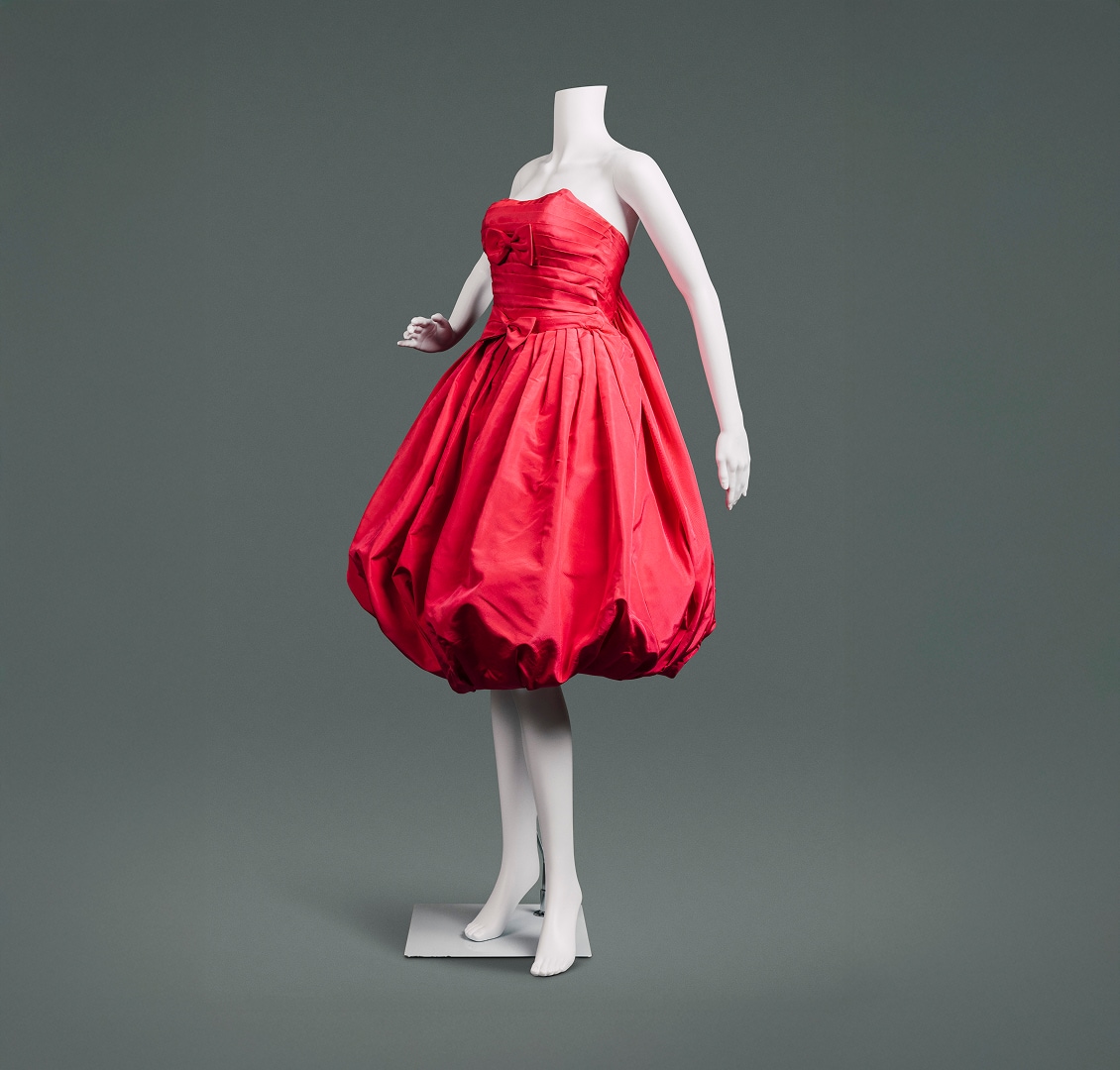
A cherry-red sleeveless silk cocktail dress with balloon skirt, sacque-back style, and red bows at the bosom and waist.

Cocktail Dress

c. 1958–1963 | American, silk

In 1957, Christian Dior introduced balloon skirts into his collection. The following year, Cristóbal Balenciaga did the same. The style was not universally accepted, but it became a much-imitated novelty.

This example is a fine copy of a French original. An eccentric feature is the sacque-back style revived from 18th century fashion (as seen in the robe à la française included in this exhibit).

Label

Whitney for I.MAGNIN & Co.

Collection

Ivan Sayers collection

Loading…
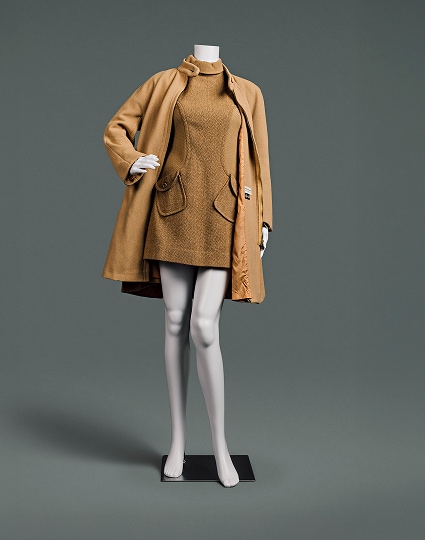
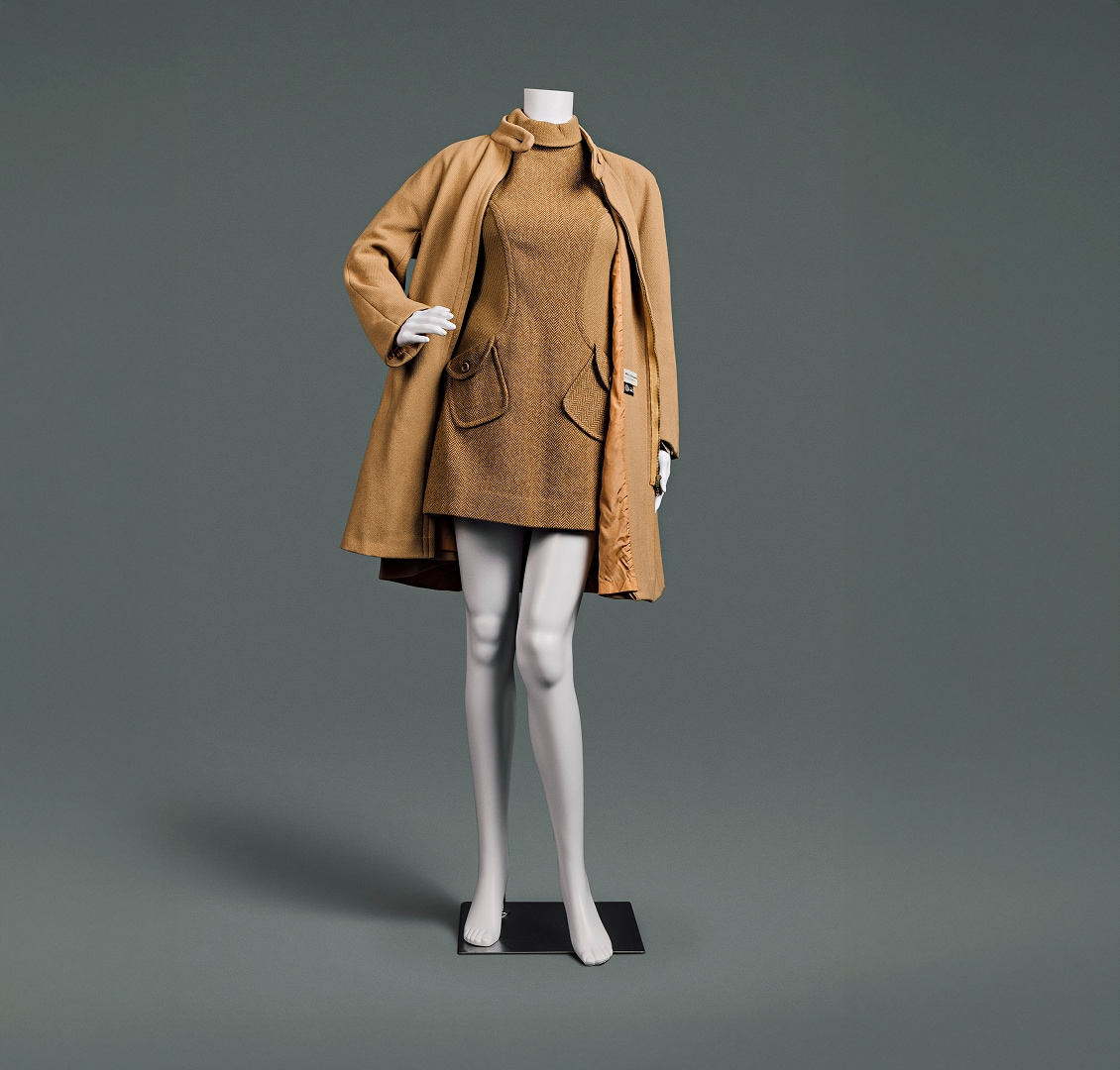
A very short camel-coloured, turtleneck wool dress with herringbone pattern and angled pockets accompanied by heavy camel coat that comes down to just above knee.

Day Dress and Coat

c. 1965 | English, wool

The style of these garments is geometric and extremely short. The exposure of the legs is the main design feature. The designer, Mary Quant, is credited with popularizing the miniskirt and pantyhose, which this new style necessitated.

Label

Mary Quant’s Ginger Group

Collection

Ivan Sayers collection

Loading…
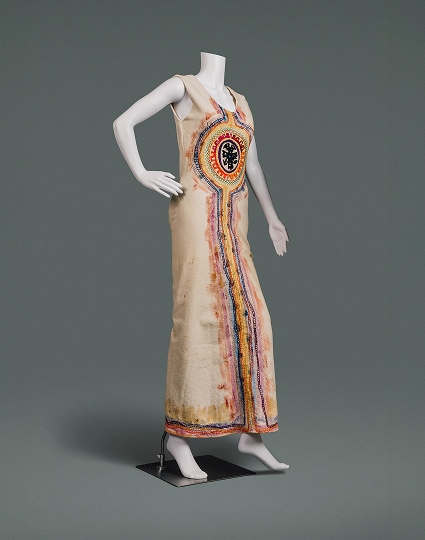
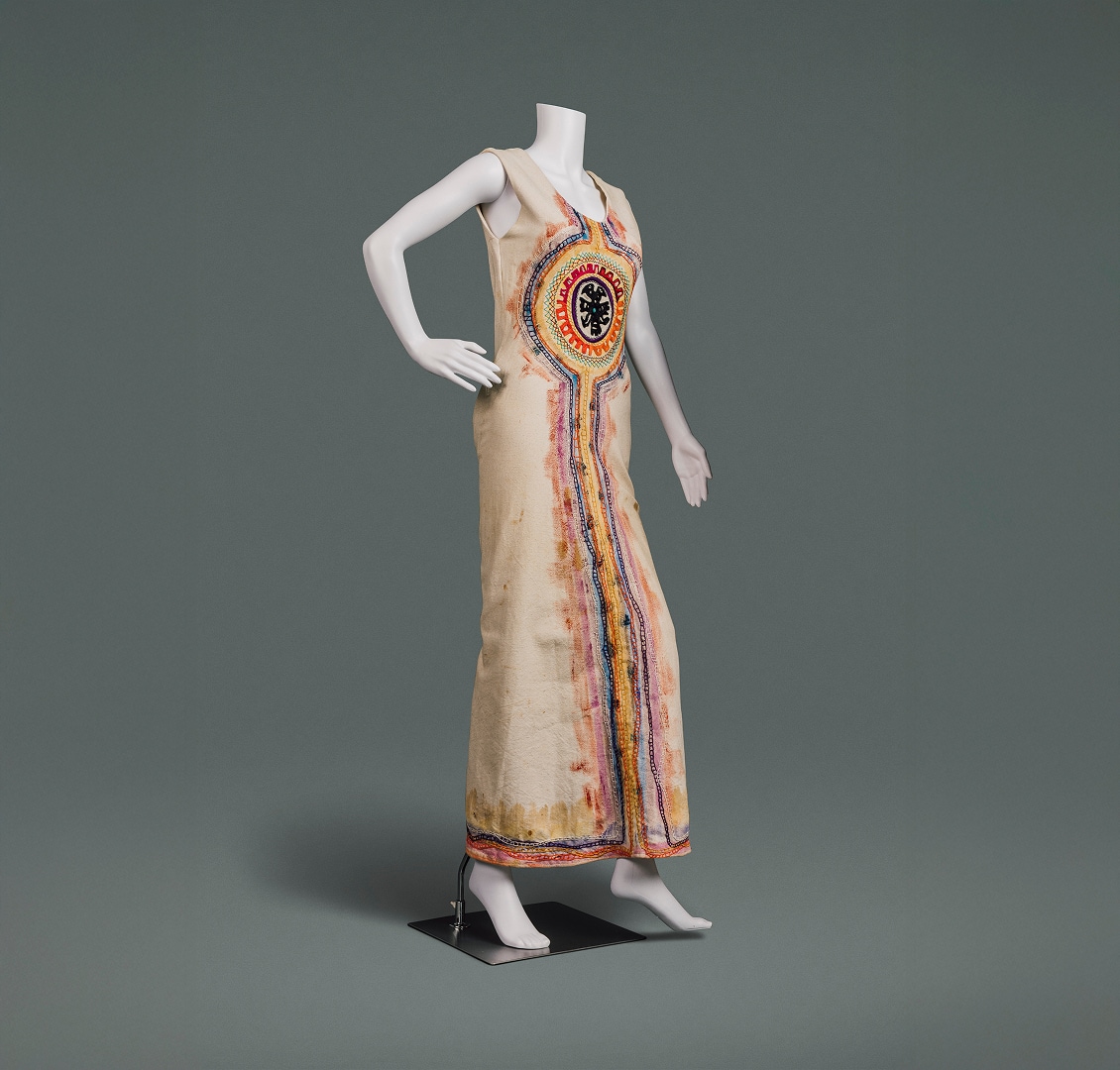
A full-length natural cotton shift decorated with painting and embroidery influenced by folk art traditions.

Special Events Dress

c. 1968 | Canadian, cotton

This handmade dress of natural cotton is a simple shift decorated with painting and embroidery. The decoration suggests influences of multiple folk art traditions.

This garment was designed and crafted by Kate Clifford of North Vancouver for her own wardrobe.

Collection

Ivan Sayers collection

Loading…
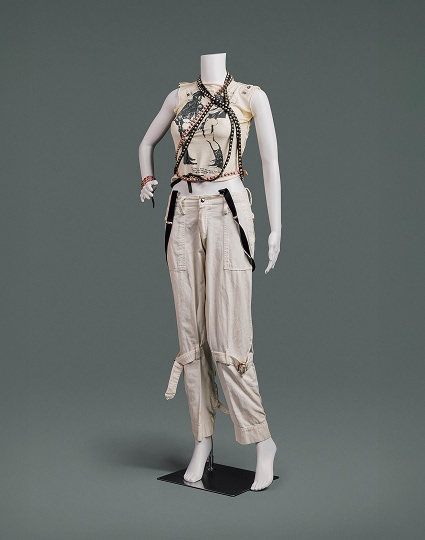
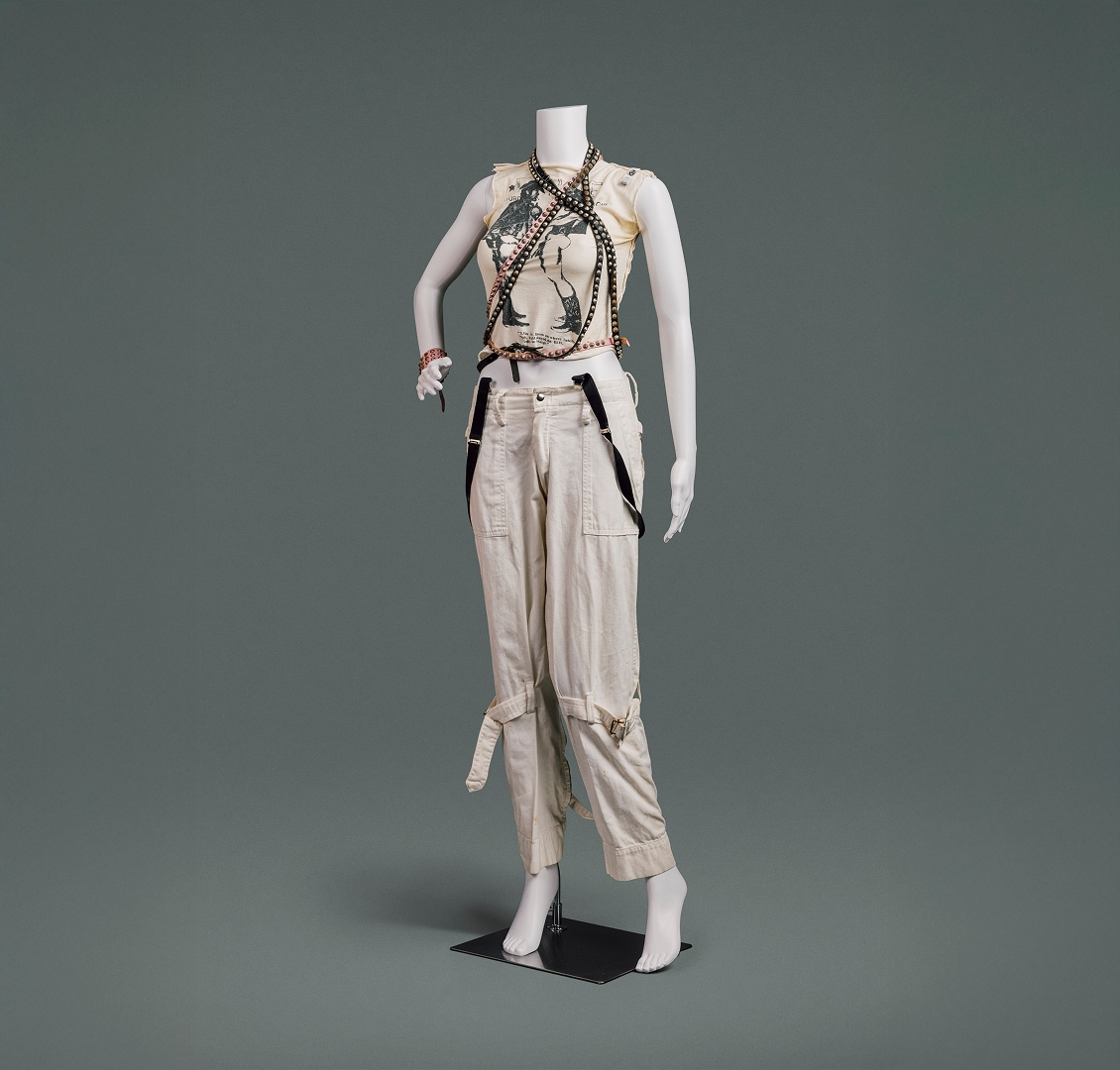
A t-shirt with ripped sleeves and Vivienne Westwood’s iconic “Two Cowboys” print on its front, cream-coloured cotton pants with large pockets and stitched belts that tighten around each leg above the knee, and black and pink studded leather belts draped around the neck overlaying the t-shirt.

Trousers and Top

c. 1976 | English, cotton

Vivienne Westwood and her partner Malcolm McLaren were the driving force behind punk fashion in London in the 1970s. Their styles were urban and tough and included influences of 1950s biker styles, mixed with the absurdity of unnaturally coloured hair, startling face make-up, piercings and tattoos. Malcolm McLaren was the manager of the punk band the Sex Pistols.

Collection

Ivan Sayers collection

Loading…
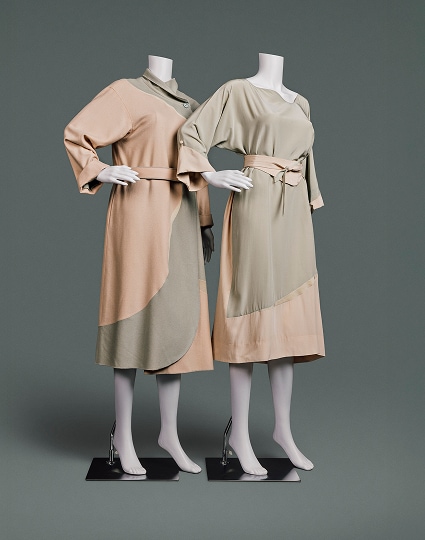
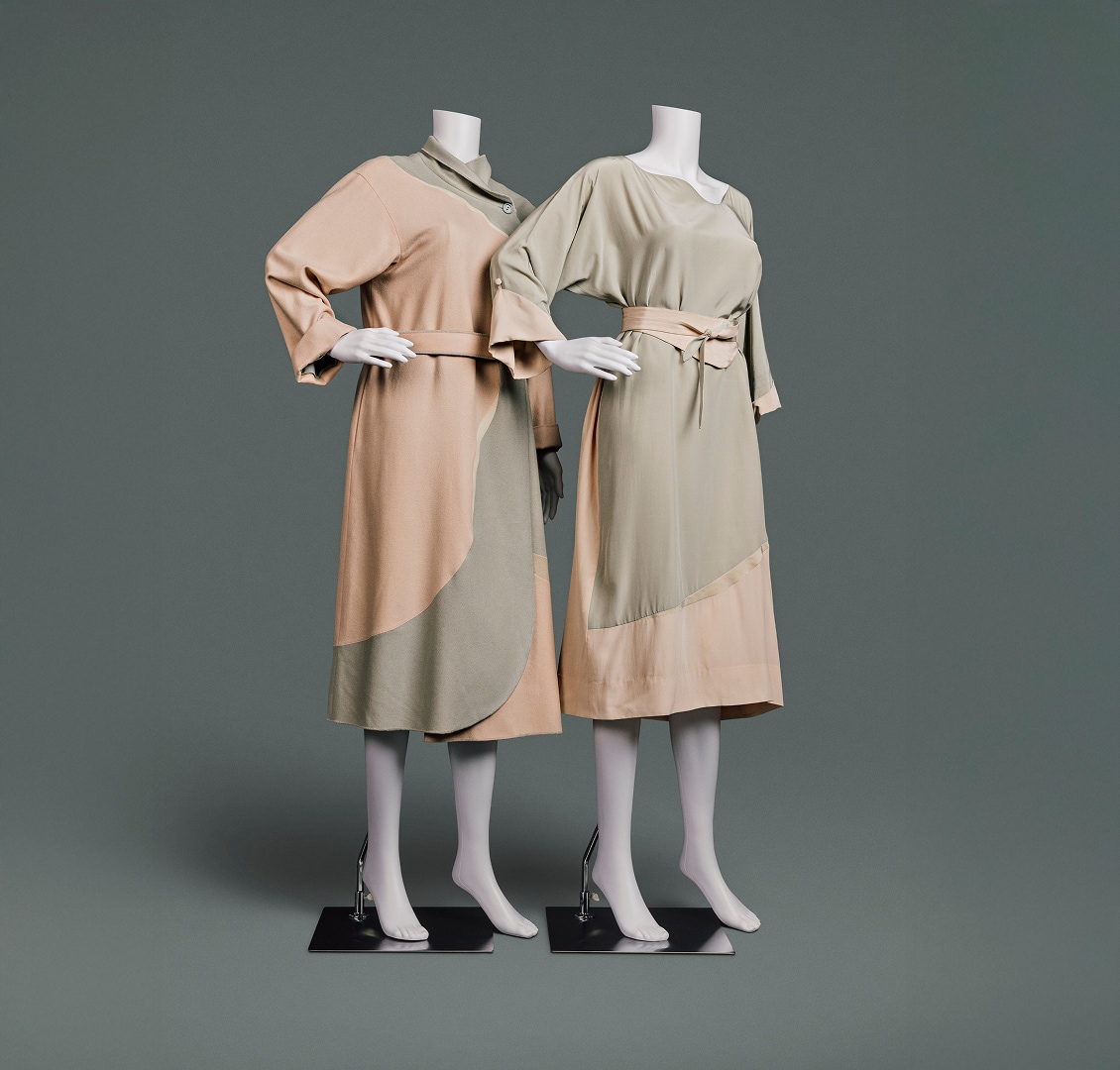
Loose-fitting silk and wool two-coloured dress and jacket. Each is designed with curved shapes where peach- and khaki-coloured fabrics meet.

Day Outfit (coat and dress)

c. 1985 | Canadian, silk and wool

This outfit has the loose fit typical of the 1970s and 1980s but brought up to date with enormous shoulder pads. The curving seams of the piecework are sewn with great skill.

It was made by designer Lore Maria Wiener for Jeannie (Mrs. Gordon) Southam, local socialite and first female member of the Board of Directors of the MacMillan Bloedel Company.

Mme. Wiener was born in Germany and trained in Austria. She and her family fled Nazism in 1940 and went to Shanghai. In 1949, they were forced to move again after the communist takeover of China. They came to Vancouver, where she became one of the city’s leading fashion designers.

Label

LMW (Lore Maria Wiener)

Collection

The BC Society for the Museum of Original Costume (SMOC) collection

Loading…
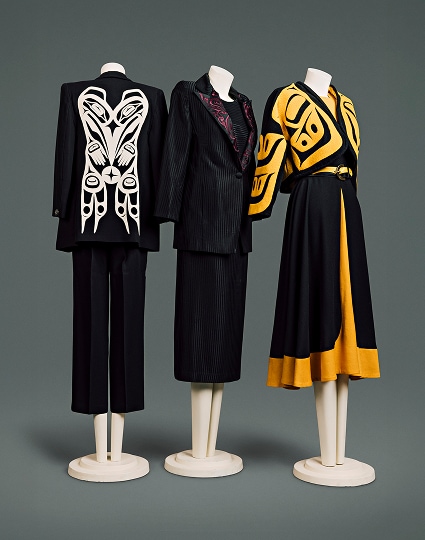
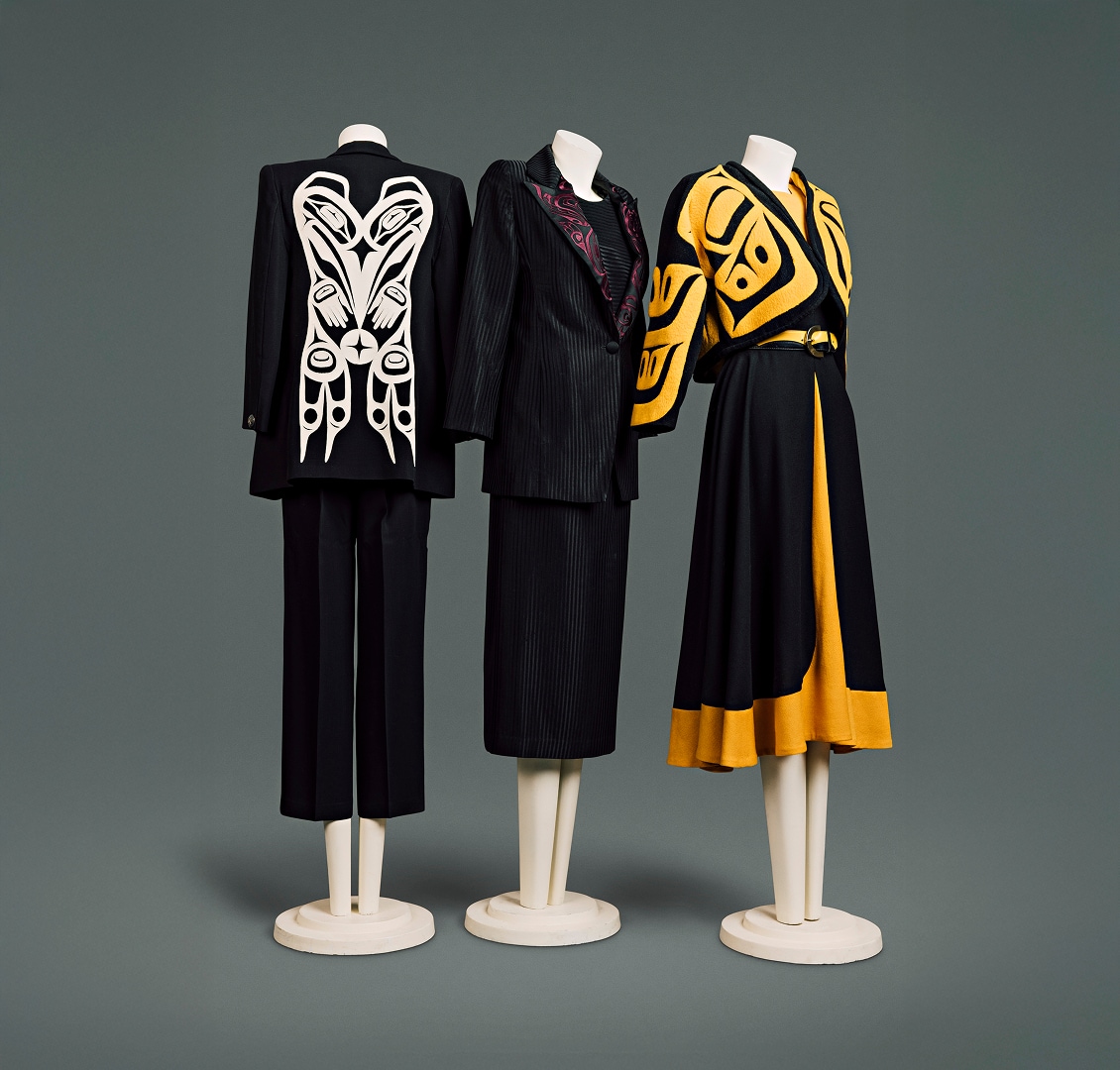
A collection of three contemporary wool suits for women. The first has a black jacket with prominent white Haida motif on the back panel and black pants which come down to mid-calf. The second is made of black pin-striped material with red haida motif on the lapel of the jacket. It is accompanied by matching blouse and a skirt which comes down just below the knee. The third has a shorter, cape-like black jacket, patterned with prominent bright-yellow Haida motif, over a yellow blouse, and yellow-and-black skirt which comes down just below the knee. It is accented by a black-and-yellow leather belt with simple crescent-shaped buckle.

Day Suits

1991 | Canadian, wool

Haida fashion designer Dorothy Grant first appeared on the Vancouver fashion scene in the 1980s. Her collections helped lay the foundations of Vancouver’s Indigenous fashion scene. Her designs combine traditional Haida motifs with contemporary fashion and European tailoring. Her styles are beautiful, practical and adaptable.

The yellow and black outfit was donated to SMOC by Penny Priddy, who wore it when she was sworn in as a member of the Legislative Assembly of BC in 1991. This garment is shown with two other Dorothy Grant suits from Penny Priddy’s wardrobe. These garments feature Haida designs whose authorship is disputed within the Indigenous community. They are displayed here with respect for these perspectives and for the significance of the garments.

Label

Feastwear Dorothy Grant

Collection

The BC Society for the Museum of Original Costume (SMOC) collection

Loading…
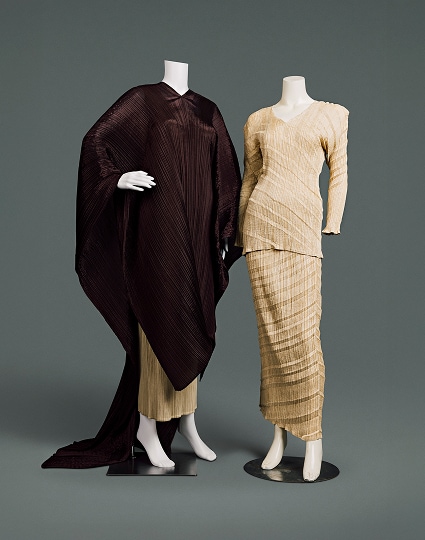
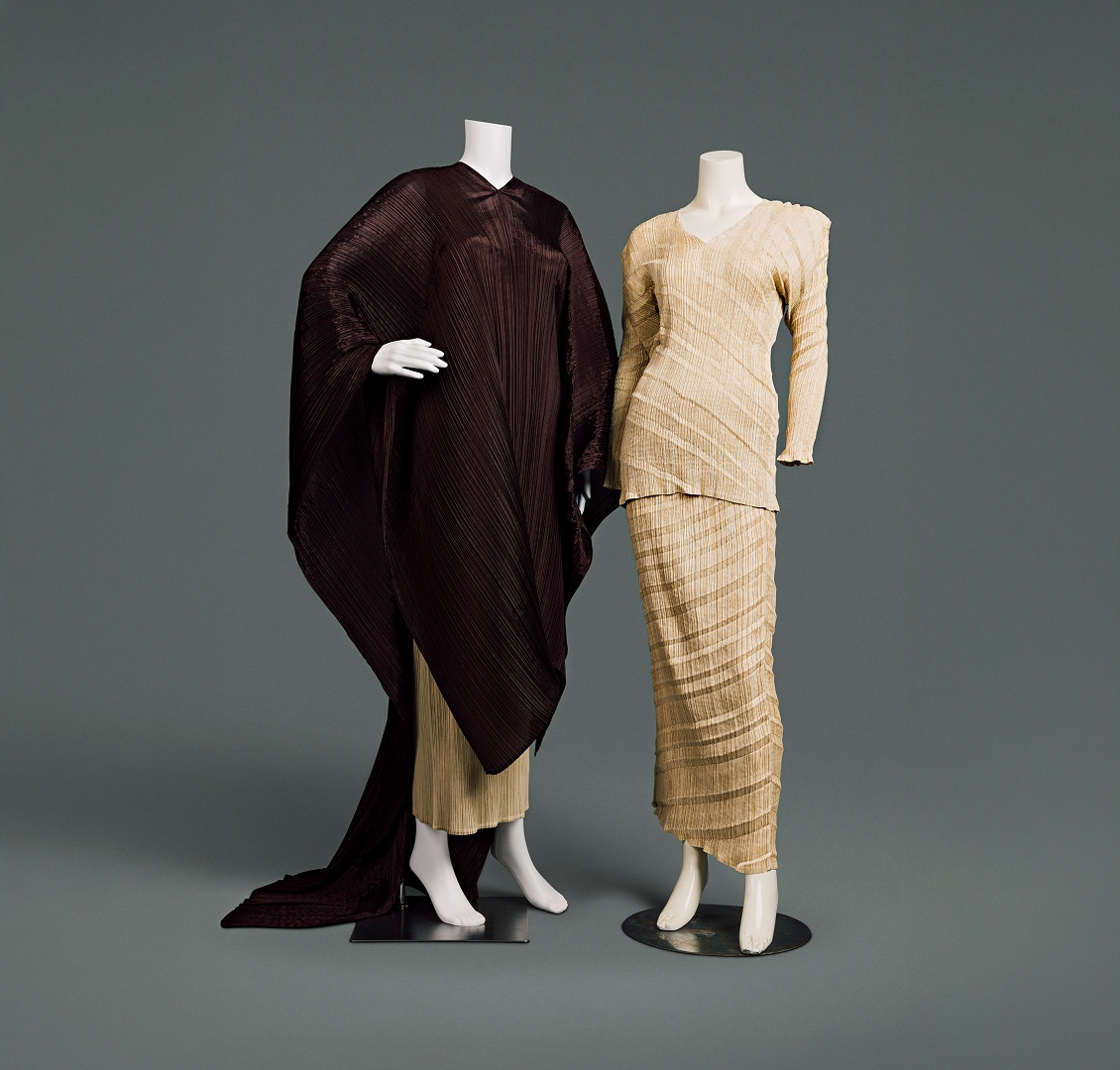
Two contemporary ensembles made of polyester. The first consists of a form-fitting, tan-coloured blouse and full length skirt, whose material is crinkled vertically and striped with horizontal diagonal shades. The second consists of a similar skirt mostly covered by a rich brown tunic blanketing the arms and body, extending below the knees in the front and trailing onto the floor like a long cape at the back.

Evening Ensembles

c. 1998–2000 | Japanese, polyester

Miyake studied art and design in Japan before working in Paris for Guy Laroche and Givenchy, and in New York for Geoffrey Beene. Miyake opened his own studio in 1970. His work is often avant-garde, but in these garments, he shows the influence of the pleated dresses made by Mariano Fortuny in Venice from 1906 to 1940. The brown tunic is inspired by traditional robes worn by Japanese men and can be draped any way the wearer wishes. Miyake has done old things in new ways and made art.

Label

Issey Miyake

Collection

Ivan Sayers collection