Video Transcript
[music]
[The delicate, white lacy patterns of a two wedding dresses appear.]
[music]
When considered within the context of their personal stories, these dresses cease to be simply garments. They are truly artifacts.
[Superimposed over the skirt of one of the dresses, the title: “A Tale of Two Wedding Dresses.” A bearded man stands with the two dresses, both fitted on female mannequins.]
[music]
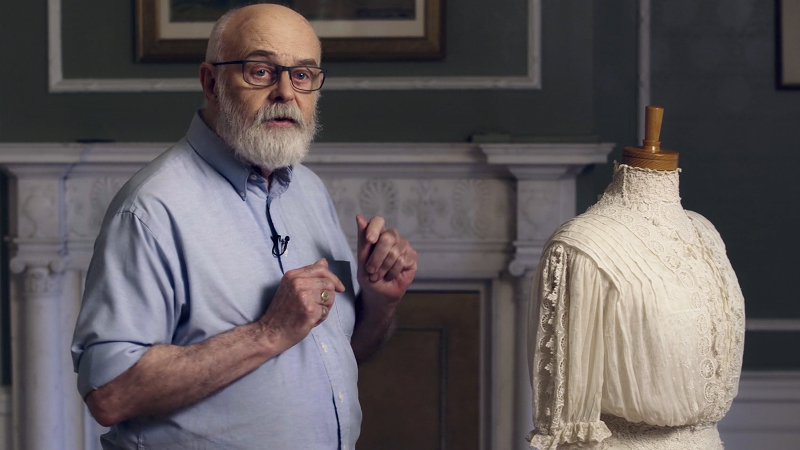
Hello, my name is Ivan Sayers. I’m a fashion historian and a museum curator. Today, I’d like to share with you two wedding dresses, or rather, two historical artifacts. Both were owned by women who lived in the Canadian prairies during the first half of the 20th century, and both dresses are beautiful. What defines them as artifacts, however, are the opposing stories of the women who wore them.
[To Ivan’s left stands the more frilly, lacy dress of two.]
The first wedding dress was worn by a Mrs. Tuff, who was married in Glasgow, in Scotland, somewhere around 1908. In 1911, she and her husband immigrated to Canada, and they started a farm outside of Winnipeg. The Tuff wedding dress, as I call it, is designed in the Art Nouveau style with flowing lines and much ornamentation typical of the era’s ideals regarding youth and femininity. The dress is made of cotton and features both machine-made Valencia lace and chemical lace insertions that you can see right there.
[Lacy circles with a flower motif.]
Under the dress, she would’ve worn layers of undergarments that included a shift,
[He motions to the dress’s waist.]
a corset, stockings, possibly attached to the corset or with a separate garter belt, a bust improver, a bustle pad at the back of the hips, bloomers or under drawers, a camisole, and a minimum of three petticoats. All of those bits and pieces help to make this silhouette. It is when the dress is viewed from the side that we get the full effect of all those underpinnings. A silhouette actually designed to be viewed in profile. The exaggerated female body remains fully covered from neckline to floor, creating an appropriate balance between modesty and physicality.
[A close-up view of the torso reveals the dress’s layers of underpinning.]
When the Great War began in 1914, Mrs. Tuff’s husband enlisted with the Canadian army and went to fight in Europe. In his absence, she ran the farm and looked after their two little girls by herself. Time passed, she received news that he had been wounded twice in gas attacks, but she was relieved to learn he had survived. When a third telegram arrived stating that her husband was missing in action and presumed dead, she refused to accept this as fact.
[A front view of the dress highlights the lacy patterns and elaborate stitching.]
She placed their two daughters with a neighboring family and journeyed to war-torn Europe, determined to find her husband.
[Pearly-colored buttons secure the front of the dress.]
Once there, she worked as an entertainer with the Canadian army, singing in army camps and hospitals, all the while searching for her missing husband. Incredibly, she found him in a field hospital. He was severely injured, but they were finally reunited. She was able to bring him back to Canada, where his wounds healed and the Tuff family resumed their life on the farm. A story of bravery, commitment, and truly tough love.
[With its long, vertical columns of lace, the dress’s full- length skirt flows from the waist to the floor. Lace also adorns the dress’s collar, which fully conceals wearer’s neck. Ivan now turns to the second dress.]
[music]
In contrast, the story behind this wedding dress is much more tragic. Unlike the Tuff dress, which, while beautiful, was factory-made, this elegant gown was custom-made in Winnipeg in 1930 for a high society wedding. It’s panne velvet, which means that the velvet has been pressed once it’s woven to give it the sheen of satin. It’s lined in silk chiffon and features a 14-foot train.
[The train extends out behind the dress, splayed out on the floor.]
The train appears to be a single piece but is composed of three separate panels, meticulously lined with layers of silk net ruffles and topped with silver ribbon bows near the hem.
[The dress is displayed on its mannequin in front of an elegant fireplace, turned around so that the train flows across the room.]
The gown is accentuated with a silver cord shaped into a geometric motif reminiscent of art deco. Every seam is hand-finished, a hallmark of couture houses and a testament to the invisible sewing mastered by the most skilled of artisans.
[Silvery cord forms a triangular motif on the bust.]
These high standards of couture came at a premium and were undoubtedly reflected in its original cost.
The body is typical of the 1920s style in that it’s straight up and down. However, it’s 1930, the depression is just about to begin. The natural body form is starting to reappear. The hips are clearly indicated as they would be in the late ’20s, but the skirt has added volume so that a slim waistline becomes apparent by contrast.
[The smooth fabric has a velvety appearance.]
A touch of daring shows in the yolk. It is a transparent, pale pink silk chiffon, so as the bride enters, one can imagine that it appears as if the dress is almost sliding down her body as her décolletage is nearly bare. She must have been remarkable.
We know that at some point during the year after the established wedding, the bride decided to indulge in a shopping trip to Minneapolis. She went alone but frustrated by the lack of companionship on what was going to be a long journey, she decided to turn back at the border. On her return to Winnipeg, she paid a surprise visit to the home of one of her bridesmaids, whereupon she discovered her husband. The romance, the trust, and the hopes associated with this dress were shattered in a heartbeat. The bride, distraught at discovering her husband having an affair with her friend, went home and took her own life.
[music]
As a fashion historian with few details, I can only speculate what motivated such an extreme reaction. In the 1930s, marriage largely defined a woman’s social standing and economic security, and it was a woman’s responsibility to maintain the marriage regardless of how reprehensibly her husband behaved. Of course, divorce was rarely an acceptable option.
[More close-up views of the sleek dress appear.]
I recently learned the identity of the woman who wore this dress and whose life ended so tragically, but I choose not to share it.
Her anonymity adds to the value of the notion of an artifact, and her story becomes representative of all women who experienced perceived guilt, humiliation, and despair if their marriages fell apart.
[More close-up views of the sleek dress appear.]
Understanding the events and motivations that led Mrs. Tuff to save her husband’s life or our anonymous bride to tragically end her own, makes you view each of these wedding dresses in a deeper way. When considered within the context of their personal stories, these dresses cease to be simply beautiful garments. They have a value beyond the obvious, and that’s what makes them special.
[music]

 Woven Together